Royal Society of Arts
3 HN recommenders · recommended in 5 months, 2017–2021
11:48 · 2.2M views · Oct 21, 2011
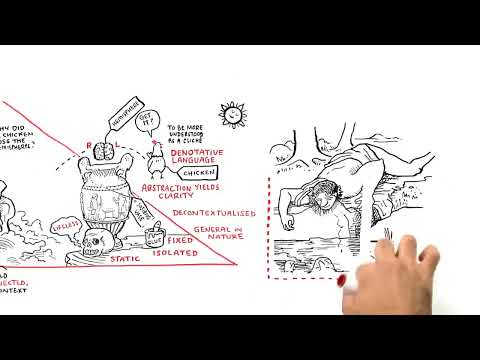
An RSA Animate summary of Iain McGilchrist's lecture on the divided brain, arguing the brain's two hemispheres attend to the world differently and that this has shaped culture and society.
Recommended as an accessible animated introduction to McGilchrist's thesis on hemispheres and narrow versus diffuse attention.
5 comments from Hacker News
I think you're right. There seems to be two sorts of attention in the mind, narrowly focused attention and broad diffuse attention. I see the goal of meditation not so much as alternating between the two modes but rather like balancing them and running them both in parallel. This entire video is really excellent, but see particularly this bit here, where Iain McGilchrist describes the concept. this video
That question has a very complex and complicated answer, hence why McGilchrist devoted the entire first half of the book to it, I can hardly summarize it here. You might want to watch the RSA Animated talk by McGilchrist: this video If this reminds you of Julian Jaynes, then yes, there exists some similarity, but, to quote Wikipedia: "McGilchrist, while accepting Jayne's intention, felt that Jayne's hypothesis was "the precise inverse of what happened" and that rather than a shift from bicameralism there evolved a separation of the hemispheres." In my opinion, it seems like a better question to ask then consists of asking if what McGilchrist describes holds 'all the way down', and I lack an answer to that.
Hey, thanks for the appreciation. Indeed, Ian Mc Gilchrist mentions how empathy is the realm of the right brain hemisphere. There is a good animated summary of his work: RSA ANIMATE: The Divided Brain this video
I want to quote at length because it's fascinating in the context of the left/right hemisphere concepts Iain McGilchrist has been best known for (especially the idea that left-hemisphere dominance is a relatively recent human adaptation): this video [LINK] [LINK] [LINK] Linguists also administered several brain exams specifically geared towards measuring Genie's language comprehension. On one such test she had no difficulty giving the correct meaning of sentences containing familiar homophones, demonstrating that her receptive comprehension was significantly better than her expressive language. Genie also did very well at identifying rhymes, both tasks that adult split-brain and left hemispherectomy patients had previously been recorded performing well on. During these tests an EEG consistently picked up more activity from the two electrodes over the right hemisphere of her brain than from those over the normal locations of the Broca's area and Wernicke's area, and found especially high involvement from her right anterior cerebral cortex, lending further support to the researchers' conclusion that Genie was using her right hemisphere to acquire language. As early as 1972 Genie scored between the level an 8-year-old and an adult on all right-hemisphere tasks the scientists tested her on, and showed extraordinarily rapid improvement on them. Her ability to piece together objects solely from tactile information was exceptionally good, and on spatial awareness tests her scores were
>(The old: left hemisphere math, right art or vice versa has been debunked if I remember correctly) As usual with biology, it's a bit more complicated than the '60s explanation ever revealed to the public. this video