Psychological Types
One of the most important of Jung's longer works, probably the most famous of his books, "Psychological Types" appeared in German in 1921 after a "fallow period" of eight years during which he'd published little. He called it "the fruit of nearly twenty years' work in the domain of practical psychology." In his autobiography he wrote: "This work sprang originally from my need to define the ways in which my outlook differed from Freud's & Adler's. In attempting to answer this question, I came across the problem of types; for it is one's psychological type which from the outset determines & limits a person's judgment. My book, therefore, was an effort to deal with the relationship of the individual to the world, to people & things. It discussed the various aspects of consciousness, the various attitudes the conscious mind might take toward the world, & thus constitutes a psychology of consciousness regarded from what might be called a clinical angle." In expounding his system of personality types Jung relied not so much on formal case data as on the countless impressions & experiences derived from the treatment of nervous illnesses, from intercourse with people of all social levels, "friend & foe alike," & from an analysis of his own psychological nature. The book is rich in material drawn from literature, aesthetics, religion & philosophy.
Stats for nerds
4recommend
17mentions
13people
2010–2025years
24% recommend76% neutral
Mentions per year
What Hacker News says
- > scientifically discredited by the mid-19th century
I mean the science is bunk but it wasn't "discredited" in the sense that you mean among the scientific community or the policy community across the West who enacted policies based on it well until after the mid 20th century.
https://en.wikipedia.org/wiki/Eugenics_in_the_United_States
> the Nazis may have adopted it, but that's proof that they weren't motivated by anything like scientific rationalism
The Nazis adopted scientific racism and this is proof they weren't motivated by scientific rationalism? I suppose your contention would be that Hitler didn't really believe any of that or something and it was all just about power. That's such a lazy position to take IMO. If you really want to die on that hill I don't think we can go forward with the discussion at least on this front. The Nazis established a whole body of thought and policies around racial hierarchies that were in part dependent on the work of eugenics and phrenology. And yes I do believe they really believed this stuff.
> But the reason I can say that Italian Fascism and German Naziism expressly adopted your Nietzschean view is because both said they did, and praised Nietzche for presenting it.
Nietzsche was highly derisive of nationalism and the examples he would deride were actually those of German nationalism. You can read Beyond Good and Evil to see that.
What you're talking about is actually highly ironic considering that Nietzsche actually predicts some sort of Hitler-like figure coming to power due to how weak-minded and herd-like Europeans were. He didn't call them herd-like as a compliment.
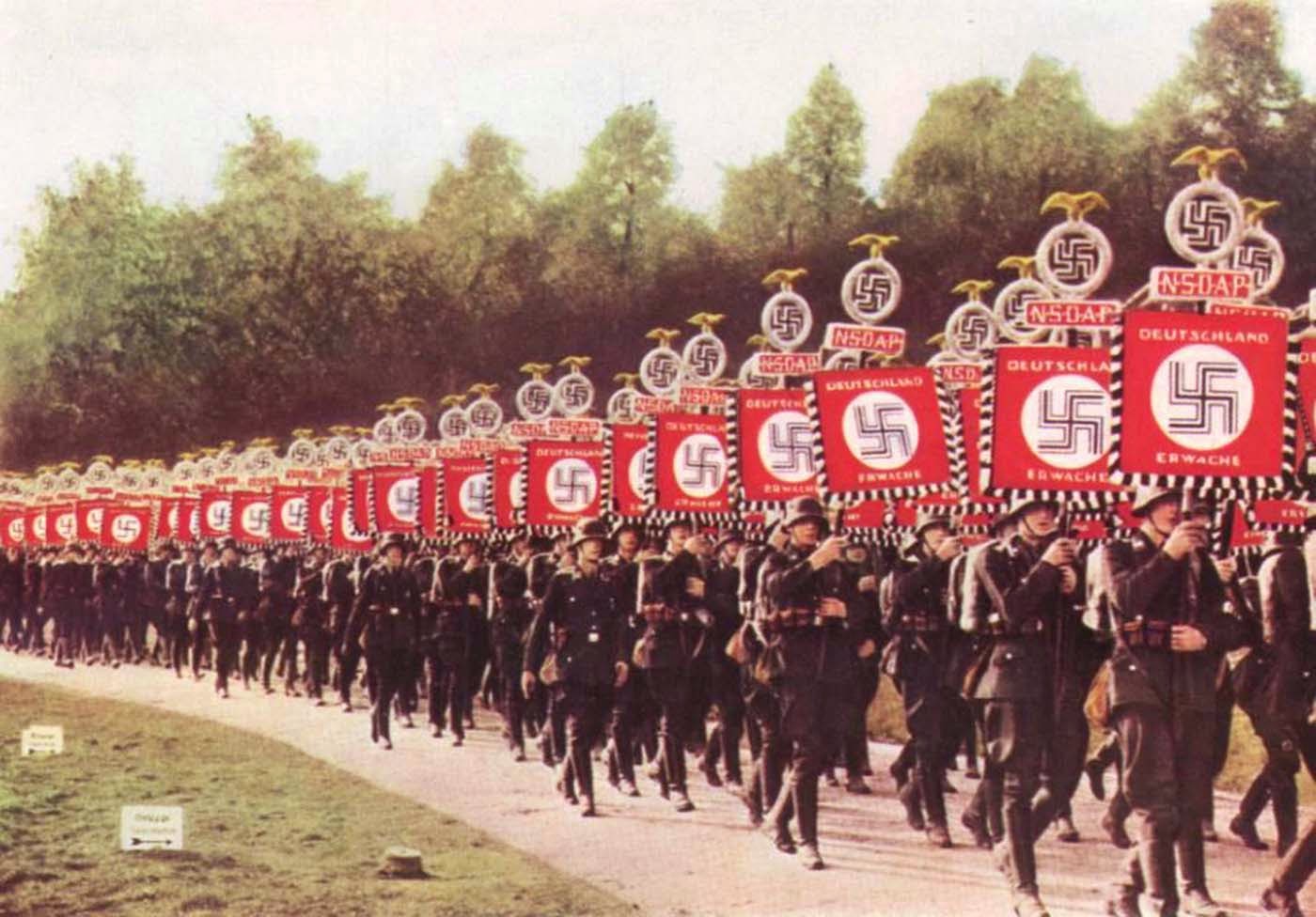
What they adopted among other things was his method of attack on morality itself and in particular Christianity and Judaism. This is what he meant by going "Beyond" Good and Evil (morality itself) to replace it with Strong and Weak or Beautiful and Ugly which was more of the Greco-Roman system of values. That does sound more like Nazism doesn't it? You can see it in the iconography of the Nazis and all the Roman stuff they adopted (e.g. the Nazi standards which harken to the Roman standards).
https://2.bp.blogspot.com/--Ngy5XGuS2Y/U_kCNxwY_5I/AAAAAAAAJ...
Nietzsche wasn't perfect IMO. You can read Psychological Types by Carl Jung who does a beautiful job of analyzing and filling in the holes in Nietzsche's positions.
- Fooled by Randomness - Nassim Taleb
Letters from a Stoic - Seneca
The Bible
Beyond Good and Evil - Nietzsche
Psychological Types - Carl Jung
- We shouldn't trivialize Jung's and Myer's work because of the pop culture surrounding it. Psychological Types and it's surrounding works (though, I haven't read The Red Book yet) contain a great deal of insight.
- Here is another:
Neuroanatomical Correlates of Extraversion and Neuroticism Christopher I. Wright, Danielle Williams1 et al, Oxford JournalsLife Sciences & Medicine Cerebral Cortex (2006) http://cercor.oxfordjournals.org/content/16/12/1809.full
If you're interested, perhaps a good place to start is Carl Jung's Psychological Types (1921), here it's in my dropbox. I had it digitized into electronic form https://www.dropbox.com/s/hrf6whb66fbmaux/Psychological%20Ty...
Many very intelligent, rational people believe introverts and extroverts exists in the population.
Here is a great talk by Susan Cain on introverts http://www.ted.com/talks/susan_cain_the_power_of_introverts....
Look forward to further discussion...
- "Almost more even than the extraverted is the introverted type subject to misunderstanding ... because the style of the epoch in which he himself participates is against him. Not in relation to the extraverted type, but as against our general occidental world-philosophy, he finds himself in the minority, not of course numerically, but from the evidence of his own feeling.
In so far as he is a convinced participator in the general style, he undermines his own foundations, since the present style, with its almost exclusive acknowledgment of the visible and the tangible, is opposed to his principle. Because of its invisibility, he is obliged to depreciate the subjective factor, and to force himself to join in the extraverted overvaluation of the object.
He himself sets the subjective factor at too low a value, and his feelings of inferiority are his chastisement for this sin. Little wonder, therefore, that it is precisely our epoch, and particularly those movements which are somewhat ahead of the time, that reveal the subjective factor in every kind of exaggerated, crude and grotesque form of expression. I refer to the art of the present day.
The undervaluation of his own principle makes the introvert egotistical, and forces upon him the psychology of the oppressed. The more egotistical he becomes, the stronger his impression grows that these others, who are apparently able, without qualms, to conform with the present style, are the oppressors against whom he must guard and protect himself.
He does not usually perceive that he commits his capital mistake in not depending upon the subjective factor with that same loyalty and devotion with which the extravert follows the object By the undervaluation of his own principle, his penchant towards egoism becomes unavoidable, which, of course, richly deserves the prejudice of the extravert.
Were he only to remain true to his own principle, the judgment of ‘egoist’ would be radically false; for the justification of his attitude would be established by its general efficacy, and all misunderstandings dissipated. "
Jung -Psychological types
"You want to be understood? That’s all we needed! Understand yourself, and you will be sufficiently understood. You will have quite enough work in hand with that"
Jung - Red book
- It's based on analytical psychology from the 1920s as Jung laid out in "Psychological Types." The funny thing is MBTI was developed for carbon copy paper and as an instrument to quickly type people. So they created the 4th column because in their scoring and layout, they couldn't indicate whether the person was more perceptive (N or S) or reasoning (T or F) focused by putting one in front of the other as Jung did, and also, in their test I guess they found it easier to figure out which function type you extraverted rather than what the attitude (introversion or extroversion) of your primary function was directly.
This leads to a lot of confusion. Jung for example might call a type "Introverted Intuitive with Feeling", and in MBTI that is INFJ, where the J means they extrovert the Feeling, but are primarily actually perceivers! Then there's Introverted Feeling with Intuition, which in MBTI is INFP, the P here meaning they extrovert intuition, but since they're primarily introverted they are "introverted feelers" foremost. I think this MBTI formulation has really made Jung's ideas unnecessarily confusing.
Also, Jung himself was not fond of people typing others, and thought people ought to learn the ideas and type themselves and of course allowed and discussed that some are not differentiated strongly in some dimensions, although he did view that as being a sort of lack of development.
So is it science? I guess I'd call it an interesting analytical model and leave it at that.