The search for the perfect language
This is the only known digital edition of this book. This edition must be read using Adobe Digital Editions, which is a separate download from Adobe.com. You can also reserve and read the book using the viewer software built into the Open Library / Internet Archive site. To read this book, download ADE and then click on the download link on the page. Point the download to ADE and wait until it comes all the way down.
Stats for nerds
7recommend
15mentions
10people
2014–2026years
80% recommend20% neutral
Mentions per year
What Hacker News says
- "The Search for the Perfect Language" is a really entertaining book if you like codes, languages, occult history, and/or chuckling at hubristic academic endeavors.
- For some reason the topic of language brings up a lot of folk theories, half truths, and downright errors. This is not a bad thing, I think a lot of people are fascinated by language and want to understand it on a deeper level. There are many excellent books on the topic.if you’re on Audible, I strongly suggest Mc Whorter’s Language Families course: https://www.thegreatcourses.com/courses/language-families-of.... He’s an expert on African languages and his coverage of those are excellent from an introductory pov.
“My language-teaching polyglot friend Benny Lewis said that if you’ve never really spoken another language, then the best strategy is to start with the easiest possible language to learn, which is Esperanto”
The advice here is very context dependent. Esperanto was based on European languages, so would be easy for a person already speaking one; if not than not. Also, the concept of “easiest possible language” of course is ill-defined and learner dependent. If you’re interested in artificial languages one interesting book is Eco’s The Search for the Perfect Language.
If I were pressed to pick an easy to learn language I’d say learn a creole language, which are relatively simplified. This is where Sivers was going with the Swahili idea, I think: although Swahili is not a creole language (https://www.reddit.com/r/linguistics/comments/4lq80i/why_isn...) contact by different populations tend to simplify complex language features. Same can be said about English, perhaps, it’s grammar and gender system is ssiplified but of course there’s the notorious spelling problem.
- Another book you may enjoy in this vein is Umberto Eco's The Search for the Perfect Language — https://www.amazon.com/Search-Perfect-Language-Making-Europe....
- One Eco's book relevant, IMO, for programmers: "The search for the Perfect Language". In a way, it can be thought of as a prequel to the history of programming languages.
https://www.amazon.com/Search-Perfect-Language-Umberto-Eco/d...
- When it comes to book recommendations I would recommend Umberto Eco's The Search for the Perfect Language.
- I'm sorry, but that sounds like something that Athanasius Kircher[1] (who created a fascinating but completely off-the-wall translation system for Egyptian hieroglyphics[2]) would say.
As far as I know, Chinese writing likely followed the same path as Sumerian and Egyptian hieroglyphs (both of which, IIRC, have well-attested archaeological evidence): originating as markings for inventory-like purposes (a drawing of two penguins => this shipment contains two penguins) and then expanding into recording spoken language.
There is a complicating factor, AFAIK, in that the earliest known form of Chinese writing, the oracle bone script used to write on bones for divination purposes, already has clear meaning as words and is possibly traceable through to modern characters.[3][4]
On the other hand, as well, "had only very vague meanings" seems to be the initial take on every untranslated writing system: Chinese, hieroglyphics, Mayan, Minoan/Mycenaean, etc.
If you're interested in this sort of thing, I recommed Umberto Eco's book, The Search for the Perfect Language.
[1] https://en.wikipedia.org/wiki/Athanasius_Kircher#Egyptology
[2] https://publicdomainreview.org/2013/05/16/athanasius-kircher...
[3] https://en.wikipedia.org/wiki/Chinese_characters#History
[4] http://www.ancientscripts.com/chinese.html
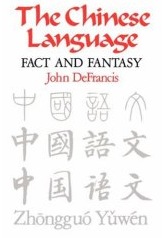
Edit: I just got to digging around and remembered that the cover of John DeFrancis' The Chinese Language: Fact and Fantasy has the same phrase in several forms of Chinese:
https://upload.wikimedia.org/wikipedia/en/7/7f/Defrancis.jpg
The top row, IIRC, is oracle bone script, the third is modern, simplified Hanzi, and the bottom is pinyin. The phrase is "Chinese Language", roughly.
Related

Talking philosophy
1 recommend · 2

The Mother Tongue
12 recommend · 22

Foucault's Pendulum
54 recommend · 124

Man's Search for Meaning
250 recommend · 394

Ur-Fascism
17 recommend · 51

The Language Instinct
44 recommend · 108

Politics and the English language
112 recommend · 263