Irrational exuberance
Irrational Exuberance, Robert Shiller returns to the topic that gained him international fame: market volatility. Shiller breaks new ground in this second edition by laying out in even clearer and starker terms the market excess that continue to destabilize the economy and disrupt our lives." "Building on the original edition, Shiller draws out the psychological origins of volatility in financial markets, this time folding real estate into his analysis. He broadens the evidence that investing in capital markets of all kinds in the modern free market is inherently unstable - subject to the profoundly human influences captured in Alan Greenspan's now-famous phrase, "irrational exuberance."" "The ultimate solution to this troubling condition, he maintains, would involve better-designed public institutions such as a revamped social security system, new forms of insurance to protect people's incomes and homes, and a broader array of investment options."--BOOK JACKET
Stats for nerds
13recommend
24mentions
21people
2009–2026years
67% recommend33% neutral
Mentions per year
What Hacker News says
- Irrational Exuberance by Robert Shiller
- > It's cycle. It always has been.
No, it hasn't always been; you're conflating historically consistent and reasonable cycles with the speculative manias that have occurred over the past two decades. Make no mistake: we are not in a normal cycle.
Prior to these bubbles, the next closest historical US analog over a century would have been the rebuilding that occurred after WWII, when home prices reverted back to inflation-adjusted fair value after the housing market was completely hammered by the onset of the Great Depression---a time when ballon payment mortgages were the norm, and a crisis that gave rise to the financial innovation of fixed-rate mortgages as the de facto US standard circa 1930s. This spike in home prices was largely attributable to a bona fide housing shortage (think Baby Boomers)...yet no speculative mania and no bubble arose over those decades.
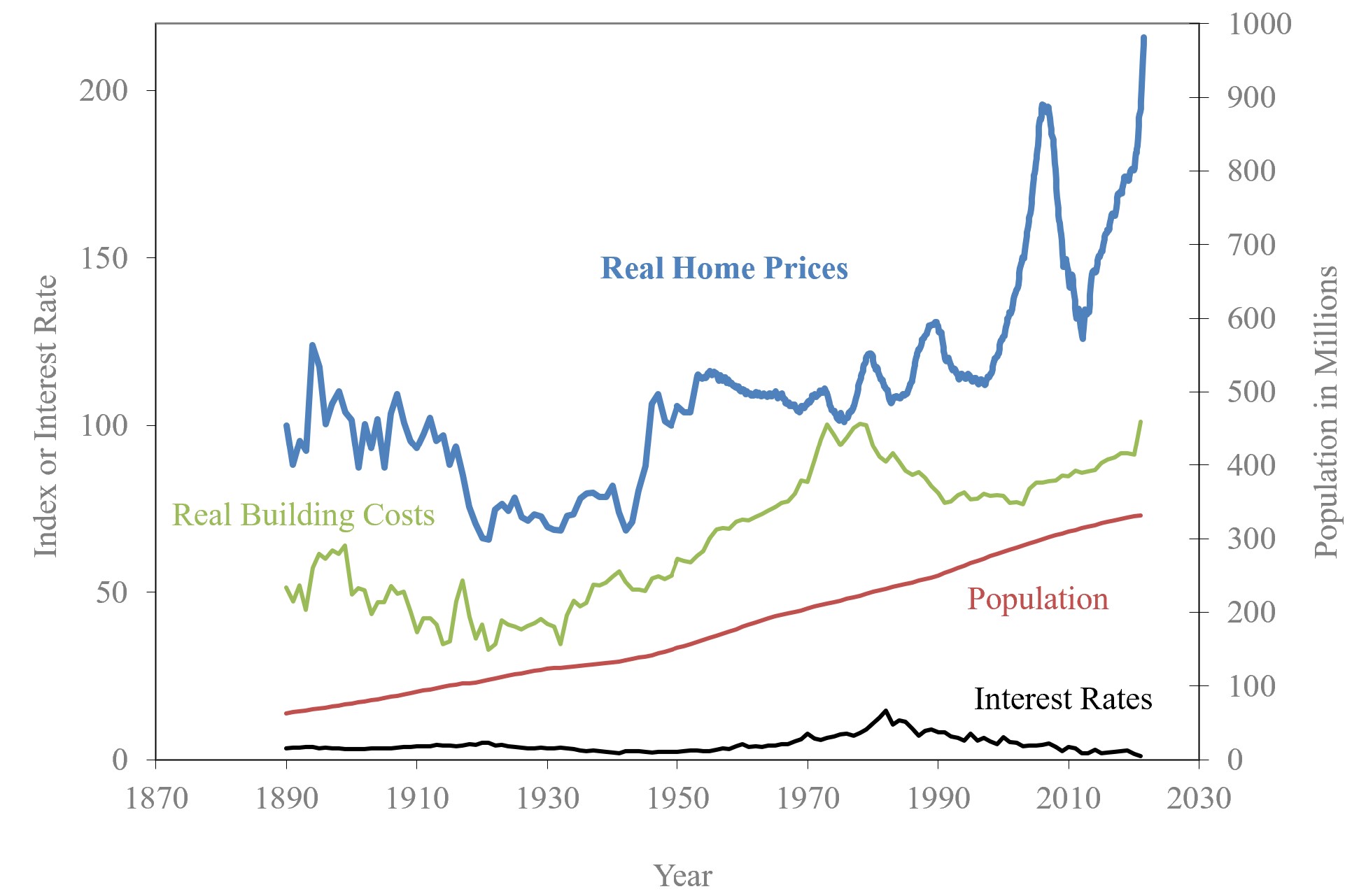
To get a sense for just how ridiculous today's real estate market has become, you need to consider the situation in real (inflation-adjusted) terms[1]. No amount of contrived marketing can quantitatively justify today's egregious bubble home prices, whether it's relative to building costs (!!), population growth, or decreasing interest rates as shown in the graph, or relative to other meaningful metrics that aren't shown like increasing real disposable income or tax-advantaged benefits of the asset class.
For reference, Robert Shiller covers this topic well in his book Irrational Exuberance[2].
On a similar note to your parent post, the UK is looking quite dire as well. Interest rates aren't as high (yet), and although both countries have a strong bias towards adjustable-rate mortgages, I suspect the key difference is in the demographic of bag holders: for the UK, I'm specifically looking at fixed-income pensioners. When the first wave of adjustments kick in next year, it's going to break a lot of people with little to no financial alternative.
- I do think there are some scary indicators (Value/GDP, CAPE, MAPE, calls/puts) which indicate we're farther along than that, but yes this could take years to reach a top. The GME escapade and the massive rush of retail investors into risky assets with perfect indifference as to whether they are investing or speculating indicate to me we're reasonably close. I have also been ridiculed many times over the last year for expressing hesitation about current valuations of Bitcoin, TLSA, GME or ARB.
Perhaps you're right though, and this has a long way to run... I'm afraid I just can't bring myself to invest in things which are overvalued due to FOMO rather than actually making money or having a prospect of making money. Old-fashioned I know.
Re pulling out of NASDAQ, I'm not sure that's a good example. You never made it back implies you lost something. You might have had indifferent returns in other assets, but not a loss. If you invested in 1999 on the other hand, you made a loss till 2013, over 10 years later, after another bubble burst. To me it is more important to avoid risk of extreme loss than attempt to chase extreme gains.
The Shiller book on Irrational Exuberance is better than the Greenspan movie IMO ;)
- There has been a recession in the US +/- 2 years of the end of every decade for the past 160+ years.
That sounds a bit hand-wavey / crystal ball / technical analysis, but has reasons in fundamentals: Several years of collective prosperity decrease risk aversion, low inflation / money targets (thus interest rates) make (over) investment cheap (offices, tall buildings, capital stock, etc), collective memory fades.
Certainly not written in stone, however. A book recommendation covering the above, and influence of such fundamentals in long term financial trends: Irrational Exuberance by Robert J Shiller.
- It is a textbook example of a speculative bubble. Shiller's book Irrational Exuberance is a great exposition on the topic. Almost every criterion he cites is satisfied: dramatic price increases, "new era" stories, mass media coverage, and stories of overnight millionaires. The only thing missing is lowered lending standards.
This doesn't mean the price will go down though, it is notoriously difficult to predict when a bubble will pop and hazardous to bet against financially.
- If you liked this, check out Shiller's book Irrational Exuberance. Released near the peak of the dot-com bubble, it covers a lot of related subjects.
Related

Economic theory in retrospect
3 recommend · 4

Predictably Irrational
83 recommend · 199

Narrative Economics
1 recommend · 7

Freakonomics
27 recommend · 71

Debt
182 recommend · 440

The Rational Optimist
18 recommend · 58
2008–2025
Predictably irrational by Dan Ariely
32 recommend · 39