Biggest Ideas in the Universe
appealing... technical accuracy and lightness of tone... Impeccable.”—Wall Street Journal “A porthole into another world.”—Scientific American “Brings science dissemination to a new level.”—Science The most trusted explainer of the most mind-boggling concepts pulls back the veil of mystery that has too long cloaked the most valuable building blocks of modern science. Sean Carroll, with his genius for making complex notions entertaining, presents in his uniquely lucid voice the fundamental ideas informing the modern physics of reality. Physics offers deep insights into the workings of the universe but those insights come in the form of equations that often look like gobbledygook. Sean Carroll shows that they are really like meaningful poems that can help us fly over sierras to discover a miraculous multidimensional landscape alive with radiant giants, warped space-time, and bewilderingly powerful forces. High school calculus is itself a centuries-old marvel as worthy of our gaze as the Mona Lisa. And it may come as a surprise the extent to which all our most cutting-edge ideas about black holes are built on the math calculus enables. No one else could so smoothly guide readers toward grasping the very equation Einstein used to describe his theory of general relativity.
Stats for nerds
15recommend
23mentions
18people
2020–2025years
74% recommend26% neutral
Mentions per year
What Hacker News says
- Sean Carroll’s Biggest Ideas in the Universe YouTube series is fantastic. Just enough math to be interesting but nothing requiring a math degree.
- Thanks for the kind words! For anyone curious to dive deeper into the crazyness that is quantum mechanics I can highly recommend a few resources:
- Sean M Carroll's work, in particular his Biggest Ideas in the Universe books: https://www.preposterousuniverse.com/biggestideas/
- Artur Ekert, basically the father of Quantum Cryptography has an amazing course for free on youtube: https://www.youtube.com/@ArturEkert . It's a very precise and understandable explanation of quantum computing, and some of the math that is involved with quantum mechanics.
- If you have hours to spare, watch Richard Behiel's videos on Youtube. He's like the 3Blue1Brown of Quantum Physics. His latest video on superconductivity and the Higgs Field is almost 5 hours long (!!!) https://youtu.be/DkH1citHtgs?si=-yQNYDu9TlTpE1A0 . It builds on his other videos, so I'd recommend starting at the beginning.
- Carroll's latest book "Quanta and Fields: The Biggest Ideas in the Universe" is about all this quantum field theory, and I think it perfectly covers the gap between pop-sci and academic material for people with some math exposure.
While other authors just keep shy of equations and thus need to resort to simplified analogies, Carroll is not afraid of throwing a good share of math stuff and explaining the rationale from one equation to the other, while avoiding the really hard parts ("solving this equation tortures undergrad physics students for a year, but we won't be doing that")
- The Biggest Ideas in the Universe 1: Space, Time and Motion by Sean Carroll
Very approachable introduction to the math behind classical physics.
- Yoy may want to check out Sean Carroll's book "The Biggest Ideas in the Universe" vol. 1. He explains a bit of calculus, how to read and understand equations etc. Basically, this book contains a crash course in physics-related math smeared out across a few chapters. Perfect for noobs like us.
- I understand the analogy you're trying to make, but that particular one doesn't track. Dark matter is required by quantum mechanics. Sean Carroll had a great explanation of this in his Biggest Ideas in the Universe video series. The models of particle creation in the early universe require there to be something with the characteristics of a class of particles holding the label "dark matter."
"Structural racism," "inequity," and "implicit bias" all mean very different things.
Structural racism is where a society is deliberately constructed to be racist, as under Apartheid in South Africa. (It is otherwise nonsensically applied to current Western governments that employ capitalism as an economic system.)
Inequity is the state of receiving disparate treatment. It can be caused by structural racism, by personal racism, or by empirical discrimination (person A is denied a mortgage because their income indicates they likely cannot afford to pay the loan back, whereas person B is granted the mortgage because their income indicates they likely can).
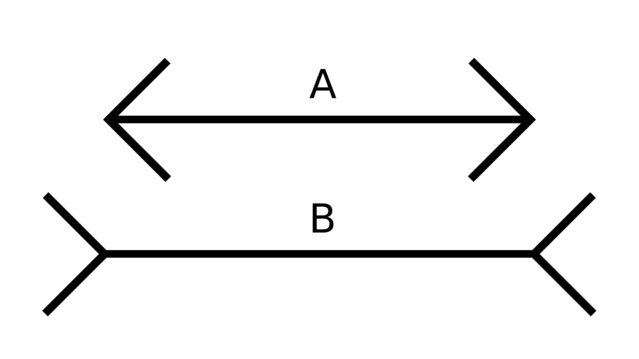
Implicit bias is an actual psychological phenomenon where quirks in the way humans think affect their judgement. The classical example is to take two parallel line segments of equal length where the ends are lined up. On one segment draw arrowheads pointing outward, on the other, arrowheads pointing inward. When asked, humans will visually judge the line segment with arrowheads pointing inward as being longer than the one with arrowheads pointing outward [1]. Convincing yourself the line segments are of equal length requires measurement. That this occurs is true. That it is the great bugaboo of our times and the cause of inequity has a far more tenuous connection to reality.
That these phrases are used as proxies for "bad" is the real problem. We can agree that structural racism is evil. Inequity occurs for the full spectrum of reasons, some immoral, some moral, some merely neutral and reasonable. Implicit bias simply is. The hard part is separating out acculturated bias (like racism) from implicit bias. One evaporates in the face differing environments. For example, children that grow up in integrated schools and integrated neighborhoods are far less likely to suffer from racist attitudes. The other is a cognitive feature that must be countered with measurement (empiricism) or rules (equally applied).
Those attempting to use the terms as umbrella labels diminish our ability to talk about and address issues arising from them. It isn't a single dark force, and there isn't a giant conspiracy out to perpetuate all perceived societal ills.
[1] https://cdn.psychologytoday.com/sites/default/files/styles/i...
Related
2024
Quanta and Fields
2 recommend · 2

From eternity to here
7 recommend · 11

The Big Picture
7 recommend · 13

Our Mathematical Universe
32 recommend · 57

Mysteries of Modern Physics
2 recommend · 4

Cosmos
58 recommend · 148

The Universe in a Nutshell
6 recommend · 17