Duty
The former Secretary of Defense offers a candid account of serving Presidents George W. Bush and Barack Obama during the wars in Iraq and Afghanistan.
Stats for nerds
3recommend
8mentions
7people
2014–2022years
38% recommend63% neutral
Mentions per year
What Hacker News says
- Not true. This topic is more complex then simply replacing the F-22 with F-35 as most government decisions on multi-million dollar projects with state interests in mind are.
The F-22 was cancelled because the military thought that they didn't needed to spend the money on air superiority fighters and wanted to use the money elsewhere (drones and bombers). I don't think the F-35 was in the discussion that much... they fired the top leaders of the Air Force at this time.
Robert Gates killed the F-22 and fired the chief of staff of the Air Force Moseley and secretary Wynne. Since then we knew it was a mistake and tried to restart the F-22 line. It didn't make sense for cost.
Gates has his own book Duty which references this quite a bit and is a great political read https://www.amazon.com/Duty-Memoirs-Secretary-at-War/dp/0307...
And there is another book that argues it was a bad idea. https://www.amazon.com/Air-Power-Abandoned-Betrayal-Americas...
Also:
https://www.thedrive.com/the-war-zone/20472/retired-general-...
https://www.airforcetimes.com/news/your-air-force/2018/05/10...
This one is funny because they talk about the increased costs of the B-2 due to cutting it early..... as they cut the F-22.
https://www.airforcemag.com/schwartz-in-memoir-says-f-22-was...
- Here's a reply[0] to a question that asked about directory structure.
Ignore the programming/technology part.
Military books (such as "One Bullet Away" by Nathaniel Fick or "Generation Kill" by Evan Wright which was turned into a mini-series on HBO). Field manuals can be interesting and you can learn a lot from them.
Knot books.
"Duty: Memoirs of a Secretary at War" by Robert Gates is interesting.
"The Art of Intelligence", by Henry Crumpton.
"Diplomacy" by Henry Kissinger is an interesting read. It starts with the balance of power in Europe, raison d'état, Richelieu, "U.S. exceptionalism". It is well written.
- "Small Unit Leadership" is also excellent and also from the US Army.
Good ones are also: "Duty" (Robert Gates) "Call Sign Chaos" (Mattis) "Extreme Ownership"
The one about Mattis has a very long list of book recommendations at the end.
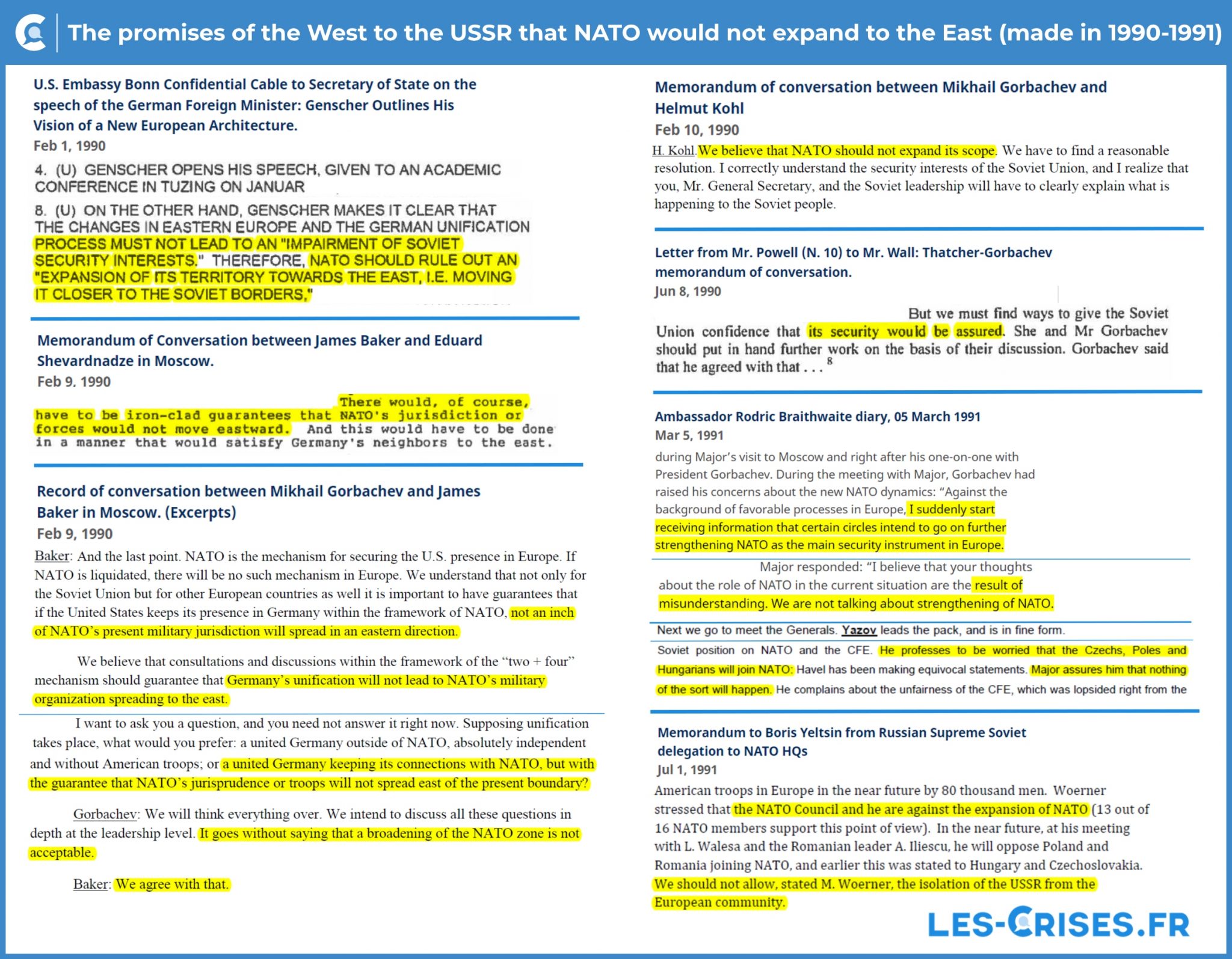
- Not really. However the position of Russians has been absolutely constant. See these excerpts from talks between Gorbachev and James Baker, Baker and Chevarnadze, with the famous "verbal assurances":
https://www.les-crises.fr/wp-content/uploads/2022/02/Promise...
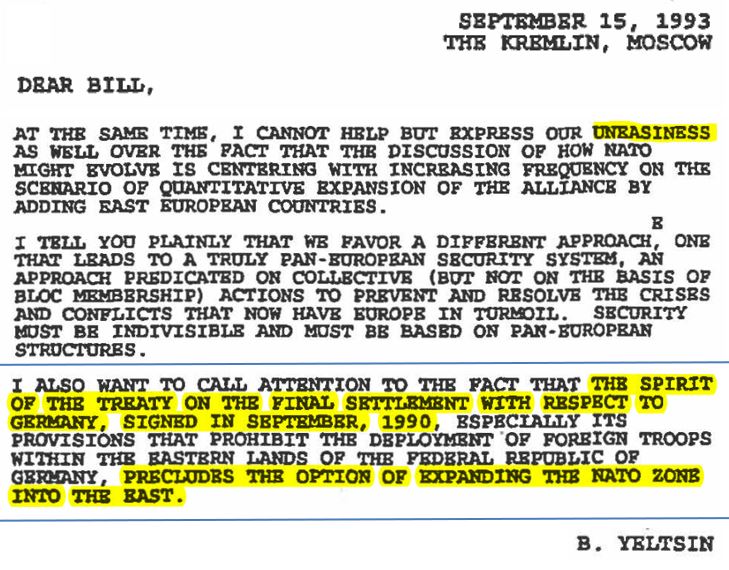
Yeltsin in this telex to Bill Clinton from 1993:
https://www.les-crises.fr/wp-content/uploads/2022/02/otan-ex...
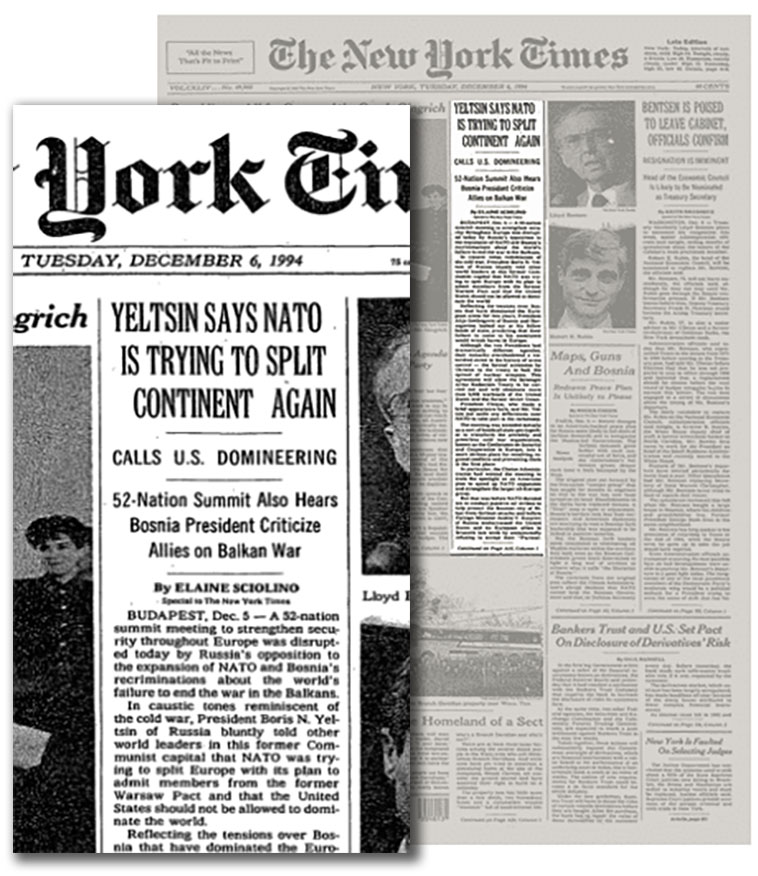
Reported in the NYTimes: https://www.nytimes.com/1993/10/02/world/yeltsin-opposes-exp...
Then came a promise from Secretary of state Christopher on 10/22/93 that there would be no extension:
https://nsarchive.gwu.edu/document/16380-document-08-secreta...
However Richard Holbrooke changed his discourse, and Yeltsin complained in 94:
https://nsarchive.gwu.edu/document/16385-document-13-officia...
Then again:
https://www.les-crises.fr/wp-content/uploads/2022/02/NT-fron...
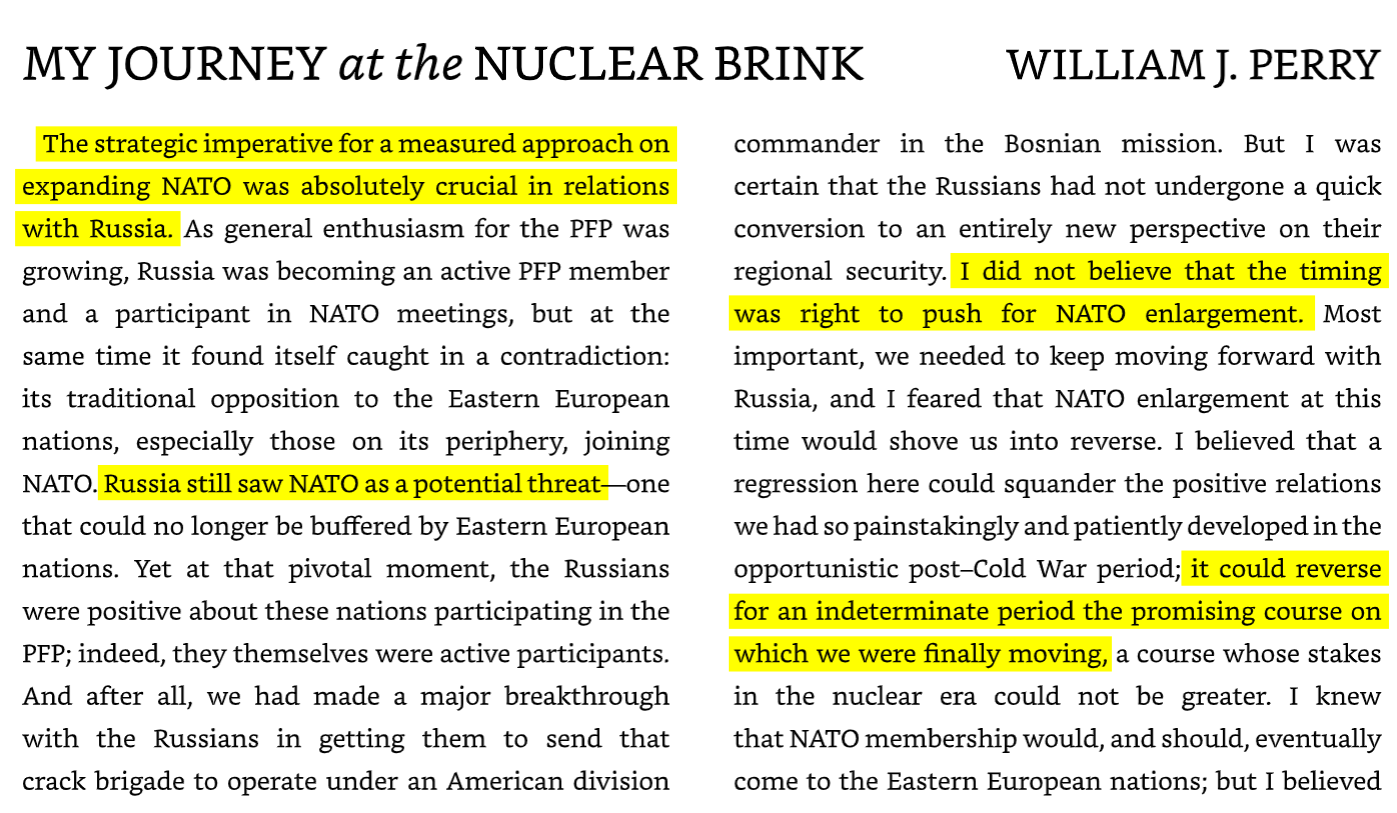
However, Yeltsine nearly died in 96, and his election relied entirely on manipulations at a large scale from the CIA. Therefore, Clinton thought he was free to proceed with NATO extension:
https://www.les-crises.fr/wp-content/uploads/2022/02/Perry-p...
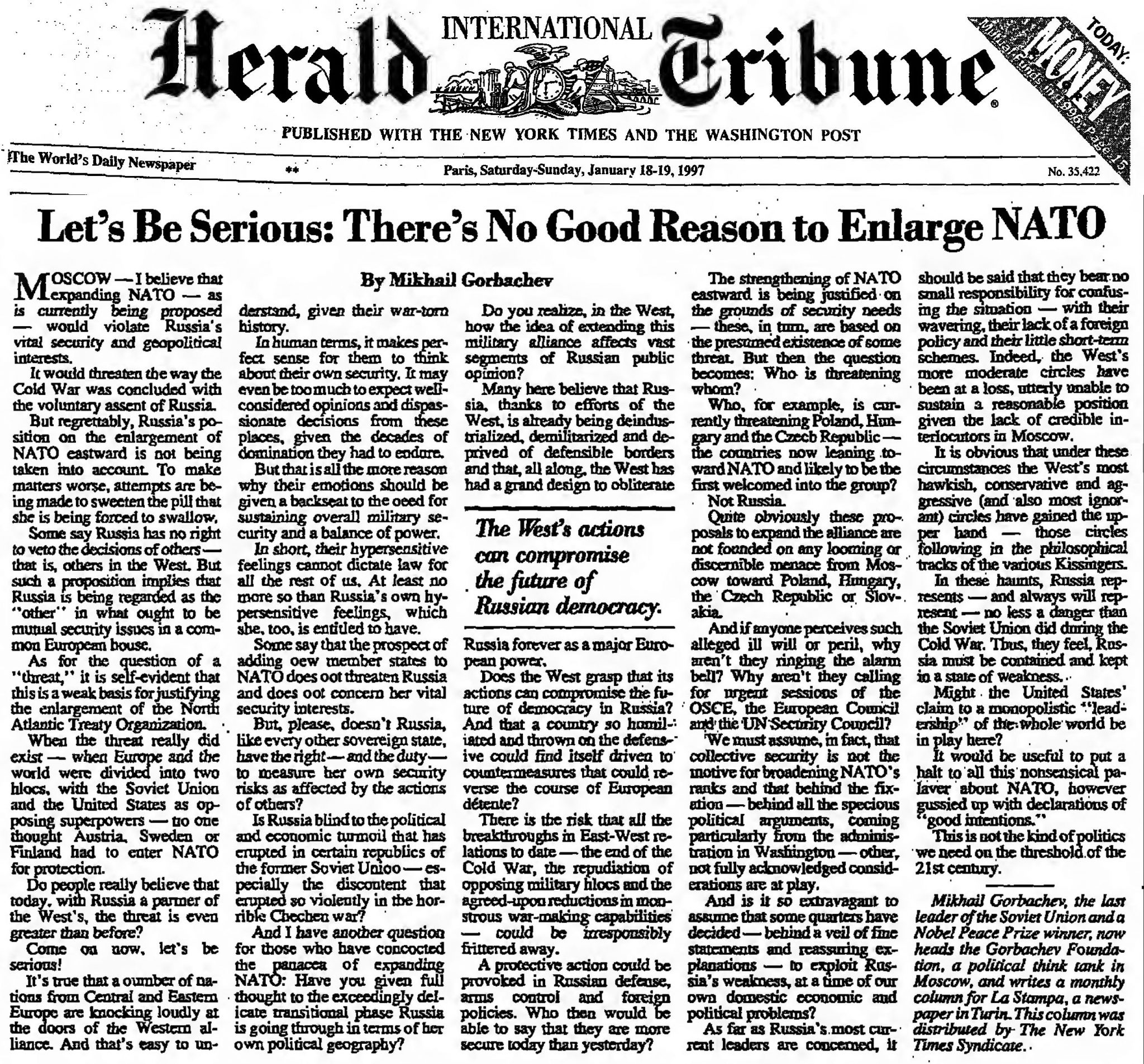
But there was large disapproval from the Russian, like Gorbachev still in this Herald Tribune 1997 guest article:
https://www.les-crises.fr/wp-content/uploads/2022/02/otan-ex...
But in the US too, like George Kennan in the NYTimes, 1997:
https://www.nytimes.com/1997/02/05/opinion/a-fateful-error.h...
and many others, Michael Mandelbaum,Richard T. Davis, John Lewis Gaddis, even Thomas Friedman thought extending NATO was a serious mistake.
> Privately, though, a few more perceptive officials acknowledged that relations with Russia had not been handled well. In his memoir, Duty, Robert M. Gates, who served as secretary of defense in the administrations of both George W. Bush and Barack Obama, made some interesting admissions. “When I reported to the president my take on the Munich conference, I shared my belief that from 1993 onward, the West, and particularly the United States, had badly underestimated the magnitude of the Russian humiliation in losing the Cold War…” Yet even that blunt assessment given to Bush did not fully capture Gates’ views on the issue. “What I didn’t tell the president was that I believed the relationship with Russia had been badly mismanaged after [George H.W.] Bush left office in 1993.” Among other missteps, “U.S. agreements with the Romanian and Bulgarian governments to rotate troops through bases in those countries was a needless provocation.” In an implicit rebuke to the younger Bush, Gates asserted that “trying to bring Georgia and Ukraine into NATO was truly overreaching.” That move, he contended, was a case of “recklessly ignoring what the Russians considered their own vital national interests.”
https://www.cato.org/commentary/did-putins-2007-munich-speec...
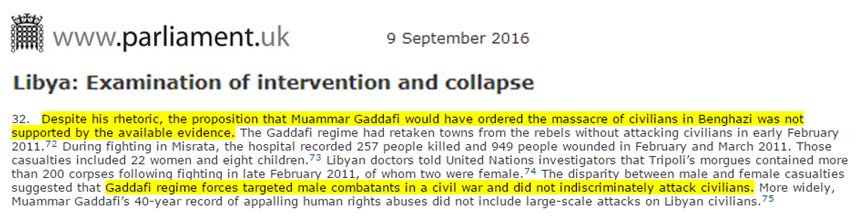
Also, there's the treachery of the 2011 Libya operation :
https://www.les-crises.fr/wp-content/uploads/2018/03/libye-0...
- According to Robert Gates' book Duty, it seems that the Saudi government has strong relationships with folks in both political parties. This appears to ensure that they get the kid glove treatment regardless of what happens. Gates describes a scenario where he was talking to the then-King in ~2006 and how the latter expected the US to just send troops wherever the kingdom needed them with no consideration for US lives; Gates describes this conversation as unforgettable and one that left him seething.
- From my understanding, parts to this jet are made all over the US so its beneficial for US to keep paying which retains jobs in so many states.
This plane is highly political and its not really easy to "pull the plug" or not pay since many states will loose workforce.
Robert Gates wrote a chapter in his book about it that was fascinating.
http://www.amazon.com/Duty-Memoirs-Secretary-at-War/dp/03079...