O'Reilly
2 HN recommenders · recommended in 4 months, 2010–2024
23:51 · 56K views · Sep 20, 2008
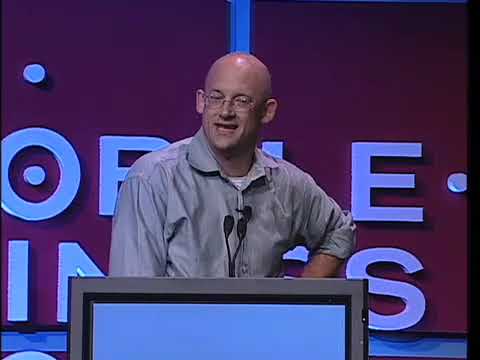
Clay Shirky argues at Web 2.0 Expo NY that the problem online is not information overload but filter failure. He says the real challenge is building better ways to filter and organize what we see.
HN invokes it as a reframing of the information overload problem, often when discussing content filtering, tagging and curation.
4 comments from Hacker News
Ted Nelson's Computers for Cynics probably doesn't contain technical information that's new to any of you, but Ted has a knack for reframing things in ways that make the arbitrariness of certain historical decisions clear: [LINK] On the subject of hypertext, The Web That Wasn't gives a nice history of the idea (for anybody who thinks it starts with TBL -- surprisingly many people!): [LINK] Another reframing-oriented talk is Clay Shirky's "It's not information overload, it's filter failure", which ultimately leads to Shirky suggesting the kinds of user-oriented filtering features that Mastodon has implemented: this video At the intersection of neurology and information science, Peter Watts always has something interesting to say, and as a former marine biologist focusing on the nervous system of starfish, this is absolutely in his wheelhouse: [LINK] This one ("moving away from defensive programming") justified strong typing in a pretty clear way: [LINK] Dan Dennett is just as relevant as Doug Hofstadter when it comes to metacognition: [LINK] Forgotten Ideas in Computer Science starts slow, but if you don't have much of a historical background (like, if you're only vaguely aware of what happened in CS in the 70s), it's a laundry list of things you should look up and be aware of before you start your next project: [LINK] Everybody should understand procedural generation: [LINK] Likewise, since AI is hyped up right now, we should all remind ourselves that IA is a thing too: [LINK] M
yay for clay and the middle way. he reminds me of uncle ben: "with great power comes great responsibility." he has a similarly level response to the problem of information overload (instead, filter failure): this video
> At some level we're tacitly acknowledging that the vast ocean of content and complexity we've created is beyond what is desirable or even healthy to effectively evaluate. I don't think there's enough useful and organized information to evaluate. There's no reason for everyone to be stuck in a vast ocean of content labeled with a handful of vague categories, except that that's just the way that someone decided to make it. If I want to figure out if I want to try a game, I can go to steam and watch a trailer, look at the tags, and still have no idea if the game is worth playing. How do I make a decision? If I just watch 3 minutes of a lets play, or a live stream, I can get an idea of what the game is like. This youtube channels thing is giving us exactly that experience. Opening a youtube video directly, on the other hand, is an entire ordeal. It's slow to load, takes up a bunch of ram, puts the video in your history and messes up the minigame of trying to micromanage the algorithm so you don't end up with bad recommendations. It's hard to just simply watch a few seconds of a bunch of videos to get a vibe. There's so much low hanging fruit in terms of content organization/discovery, it drives me insane that the experience is generally so bad, and getting worse. Clay Shirky gave a talk on this years ago (also I think it's a blog post) called "It's not information overload, it's filter failure". this video
Tagging is useful for a lot more than just finding old stuff on a topic. It's massively valuable for filtering new stuff and community management. A lot of the problems with the devolution in HN could be resolved by implementing a few common tags like, 'startups', 'programming', 'political', 'current_events', 'design' and then having different thresholds for each tag to reach the front page. IMHO, the number of votes to reach the front page for a political story should be much higher than one that is about programming. I think most would agree. With tagging pg would be able to figure out if one tag is getting out of hand and squelch it temporarily or even permanently. As the community has grown, we're suffering from filter failure ( this video ). The less HN is about stuff that is interesting to hackers, the more it becomes welcoming for people who aren't hackers, the more non-hackers that join the more up votes that non-hacker focused stories get. It's a vicious cycle and tag squelching is one good way of moderating the community and keeping it focused.