Skip to content
HomeVideos
AllLongsCategoriesPlaylists
BooksBlogsPodcasts
HistoryListsWatch laterLiked videosFollowing

The videos, books, blogs and podcasts Hacker News keeps recommending, all in one place.

VideosBooksBlogsPodcastsAboutPrivacySettings

Data from Hacker News, HackerTube, HackerBooks, HackerBlogs and Open Library. Credits · Not affiliated with Y Combinator.

HomeVideosBooksBlogsPodcasts
Ctrl K

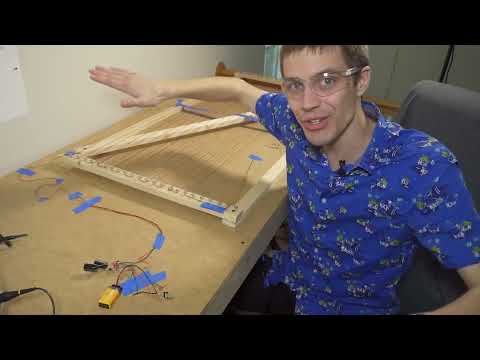
    Watch electricity hit a fork in the road at half a billion frames per second

    AlphaPhoenix

    5 HN recommenders · recommended in 8 months, 2024–2026

    YouTube

    26:29 · 3M views · Dec 6, 2023

    AlphaPhoenix uses a custom high-speed measurement setup to watch voltage waves travel down wires and split at a fork. It answers how electricity knows where to go and how quickly that process happens.

    Praised as the clearest visual explanation of transmission lines, impedance and signal propagation, with several commenters saying it made it all click.

    Hardware & ElectronicsElectronics & circuit designFundamental physicsEveryday physics & science demos
    1. 22:49
      I bought 1000 meters of wire to settle a physics debateAlphaPhoenix3.7M views • 4 years ago
    2. 28:03
      AT&T Archives: Similiarities of Wave Behavior (Bonus Edition)AT&T Tech Channel474K views • 14 years ago
    3. 14:48
      The Biggest Misconception About ElectricityVeritasium28M views • 4 years ago
    4. 24:31
      How Electricity Actually WorksVeritasium13M views • 4 years ago
    5. 2:19:51
      [LIVE] How to Achieve Proper Grounding - Rick Hartley - Expert Live Training (US)Altium1M views • 6 years ago
    6. 2:04
      Admiral Grace Hopper Explains the Nanosecondfunbury163K views • 14 years ago
    7. 19:41
      Michael Levin: The electrical blueprints that orchestrate life | TEDTED576K views • 5 years ago
    8. 29:22
      A laser pointer at 2 billion fps makes the speed of light look... kinda weirdAlphaPhoenix6M views • 1 year ago
    9. 19:17
      How Wrong Is VERITASIUM? A Lamp and Power Line StoryElectroBOOM4.4M views • 4 years ago
    10. 28:34
      But why would light "slow down"? | Visualizing Feynman's lecture on the refractive index3Blue1Brown2.9M views • 2 years ago
    11. 49:22
      James Burke Connections, Ep. 1 "The Trigger Effect"DRS_Education765K views • 7 years ago
    12. 54:35
      TSP #133 - Keysight UXR 110GHz BW, 256GS/s, 10-bit Real-Time Oscilloscope Teardown & ExperimentsThe Signal Path191K views • 8 years ago
    13. 11:23
      How a transistor worksBen Eater847K views • 11 years ago
    14. 16:47
      Lines of Light: How Analog Television WorksTechnology Connections1.5M views • 9 years ago
    15. 19:22
      Mechanical circuits: electronics without electricitySteve Mould8.7M views • 4 years ago
    16. 0:40
      Shockwave traffic jams recreated for first timeNew Scientist4.4M views • 18 years ago
    17. 11:52
      The Extreme Physics Pushing Moore’s Law to the Next LevelSeeker4.6M views • 7 years ago
    18. 1:49
      Synchronization of MetronomesHarvard Natural Sciences Lecture Demonstrations660K views • 16 years ago
    19. 11:22
      Most People Don't Know How Bikes WorkVeritasium25M views • 4 years ago
    20. 1:03:22
      What your Differential Pairs Wish You Knew with Rick Hartley - AltiumLive KeynoteAltium108K views • 7 years ago

    9 comments from Hacker News

    1. @brunohaidJan 2025· in “Oliver Heaviside and the theory of transmission lines (2021)”

      Excellent post! Controlled impedance took me a long time to wrap my head around when starting PCB design, the moment when it finally clicked was watching this excellent AlphaPhoenix video this video asking and practically demonstrating the simple question: When you flip on a switch, to turn on anything, send data, morse something etc, how does the circuit know how much current the load at the other end needs? Spoiler: Given that information can't travel faster than light, the simple answer is: it doesn't. So it just guesses and adjusts, which you don't want as it gives you exactly the ringing etc Heaviside identified. The video is a nice complement, as it perfectly visualizes the issues at play. It's a pretty wild bit of understanding to have, even in simple situations like flipping on a light switch.

      Strongly recommendsView on HN
    2. @simcop2387Jun 2024· in “Wireless power transfer system achieves 270-kilowatt charge”

      This spurred on some other videos from another youtuber that goes by AlphaPhoenix, he went way into all the details on it including measuring the complete flow of the wave of the electrical power and how it all works. [LINK] this video [LINK] (on his second channel, has a lot of "behind the scenes" of how it was done) It goes into a lot of depth of how the wave propagates, including measuring it at effectively "a billion fps" (he goes over how he does this) along the wire and how impedance matching works, etc. It's about 2.5 hours of video IIRC but it's probably the most detailed and easy to understand demonstration and explanation of all of it that I've ever seen.

      Strongly recommendsView on HN
    3. @spaceywillyJun 2024· in “Why does current flow the opposite way from the electrons?”

      As a matter of fact, yes! This YouTube video is probably one of the most amazing things I have ever seen, he measured the change in voltage traveling along a Y circuit, where one end is open and one is closed. You can see the voltage “ripple” through both branches of the circuit, reflect of the ends of the branches, and eventually settle into steady state. There are limits to this way of thinking (for example, water can’t travel in the space between “tubes”, but electricity can), but it is a very good way to approximate it. this video

      Strongly recommendsView on HN
    4. @andrewflnrDec 2025· in “Science Communications on YouTube”

      I want to hijack this comment to plug AlphaPhoenix ( [LINK] ), who is responsible for by far the best explanations of electricity that I've encountered in any format. For instance, this one that clarifies what happens when you try to send electricity on an open circuit, and (IIRC this is the right one) what impedance mismatch is actually about: this video

      Strongly recommendsView on HN
    5. @kzrdudeFeb 2025· in “But good sir, what is electricity?”

      AlphaPhoenix's measurements, experiments and visualisations really help! They show some things that are normally not even taught and even electrical engineers will appreciate to see this. This video he made about it is very good, and worth watching if you wonder about how electricity propagates from one end of a conductor to the other. this video

      RecommendsView on HN