The Tipping Point
"New Yorker writer Malcolm Gladwell looks at why major changes in our society so often happen suddenly and unexpectedly. Ideas, behavior, messages, and products, he argues, often spread like outbreaks of infectious disease. Just as a single sick person can start an epidemic of the flu, so too can a few fare-beaters and graffiti artists fuel a subway crime wave, or a satisfied customer fill the empty tables of a new restaurant. These are social epidemics, and the moment when they take off, when they reach their critical mass, is the Tipping Point.". "Gladwell introduces us to the particular personality types who are natural pollinators of new ideas and trends, the people who create the phenomenon of word of mouth. He analyzes fashion trends, smoking, children's television, direct mail, and the early days of the American Revolution for clues about making ideas infectious, and visits a religious commune, a successful high-tech company, and one of the world's greatest salesmen to show how to start and sustain social epidemics."--BOOK JACKET.
Stats for nerds
31recommend
94mentions
87people
2007–2025years
35% recommend57% neutral7% critical
Mentions per year
What Hacker News says
- Users sometimes have their choice between dealers, so the sales and personality skills will materially impact their reputation and ultimately sales volume.
Just because you have a primed customer base at your disposal doesn't mean your duties have been downgraded to being a cashier.
You need to be personable, appear tough enough to be too much trouble to rob, reliably have good products, and simple to reach/do business with.
There's a reason why Malcolm Gladwell picked the crack business in The Tipping Point. A great book you should read if you ever want to know how analogous drug businesses are to corporate america.
- The Design of Everyday Things
Ways of Seeing
The Tipping Point: How Little Things Can Make a Big Difference
- Dare to Lead -Rene Brown
Fooled by randomness- Nassim T
Principle - Ray Dalio
Drive - D Pink
The Laws of Human Nature -R Greene
Influence- Robert Cialdini
21st lessons for 21st century - Y. Harari
Why we sleep -M. Walker
Skin in the Game - Nassim T. Social Animal - David B.
Einstein - Isaacson
Steve Jobs - Isaacson
Blink - malcolm gladwell
Outlier - malcolm gladwell
The tipping point - malcolm gladwell
Game of Throne series
- The tipping point by Malcolm Gladwell is pretty good, I thought
- I got a lot out of some very practical books, like The 7 Habits of Highly Effective People, Getting to Yes, The Tipping Point and The Peter Principle. I read a lot of good fiction in my youth, including books mentioned here, like Siddhartha, works by Heinlein and the Amber series.
There are a couple of books that had a big impact on me whose titles I long ago forgot. Periodically searching has not uncovered them.
One was a history of the deep south. Another was a book about about raising money for non profits.
I grew up in the deep south. Reading a history of it helped me understand my life and my country better. The second book had some pithy passages. One of my takeaways was "Don't say no for them." In other words, don't fail to ask because you assume the answer is no.
There were some other pithy, wise bits in the book that boil down to "If you really care about this project and the people it impacts, you need to get over being a thin skinned crybaby and keep at it in spite of repeatedly dealing with rejection, etc." I think the story was repeatedly told that someone would come to her all upset about something and she would say something like "I will put on my best therapist hat and tell you to get over it."
It was a surprising attitude to run into. The author was very practical. She also talked about the fact that she kept doing what she did because when things went well, there was no better feeling. I have done a lot of volunteer work in my life and there is a whole lot of touchy feely stuff that goes along with such work. This book was a breath of fresh air.
- It's a classic speculative bubble. People are making bets to position themselves for a situation where Bitcoin will be worth a lot in the future, but the valuation is untethered from any intrinsic value.
The surge becomes self-sustaining, in that as news stories of easy wealth spread and more speculators bundle into the market, it fuels more demand from new participants looking to get rich quick. This is not sustainable in the long run, and as soon as the crowd gets spooked all the dumb money will bail out very quickly, leading to a very fast crash.
The Gladwell book "The Tipping Point" is a good read about how ideas and fads take hold in societies. It's more a function of the way information spreads than about any secret knowledge about Bitcoin. Nobody can predict the future, but Bitcoin speculation is an attempt to gamble on it.
There's an investment adage that's something like "When your barista's telling you to invest in something, it's time to get out". Have had a number of non-tech/non-finance friends ask about how to invest money into Bitcoin lately, which is a signal to me that Bitcoin is becoming dangerously overheated.
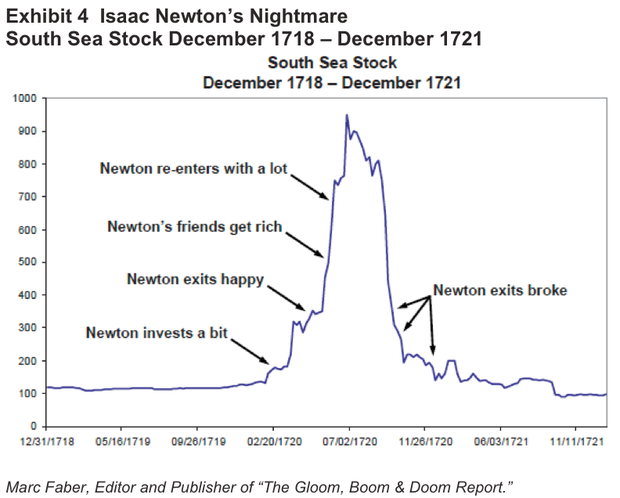
Take a look at http://static4.businessinsider.com/image/515b40886bb3f7bd490... from the South China Seas bubble in the 18th Century. The first half of that curve look familiar? Guessing we will see a lot of Newtons in the not so distant future...
(Still, I have some crypto as part of my investment portfolio, about 2% of my net worth... you never know...)