Stats for nerds
2recommend
15mentions
11people
2011–2026years
13% recommend87% neutral
Mentions per year
What Hacker News says
- What exactly are you slyly implying but not explicitly stating about Alan Turing, and where did you hear it? Which source documents did you read, and what did they say that contradicts Hodge's book? Links or scans please!
Hodges mentioned in personal email we exchanged that there's some conspiracy theorist who was spreading unsubstantiated rumors that Turing didn't actually commit suicide. And then of course there's another whack job conspiracy theorist jackass's reprehensible homophobic essay "Abusing Alan Turing" which you can search for but I won't link to.
If you're getting your information from that guy (and I certainly hope by "source documents" you don't mean his blog), then I suggest you read some of the other things he's written to get an idea of what kind of a person you're getting your information from. (Hint: add "blacks", "low IQ", "violent" to your search query.)
If instead you like reading actual source documents and the testimony of people who knew Alan Turing first hand, the preface to The Collected Works of A.M. Turing: Morphogenesis (P. T. Saunders, Editor) was written by P. N. Furbank, his close friend and legal executor, and explicitly endorses Hodge's book in a good light:
"Indeed, with the aid of Andrew Hodges's excellent biography, A.M. Turing: the Enigma, even non-mathematicians like myself have some idea of how his idea of a "universal machine": arose - as a sort of byproduct of a paper answering Hilbert's "Entscheidungsproblem"." -P. N. Furbank
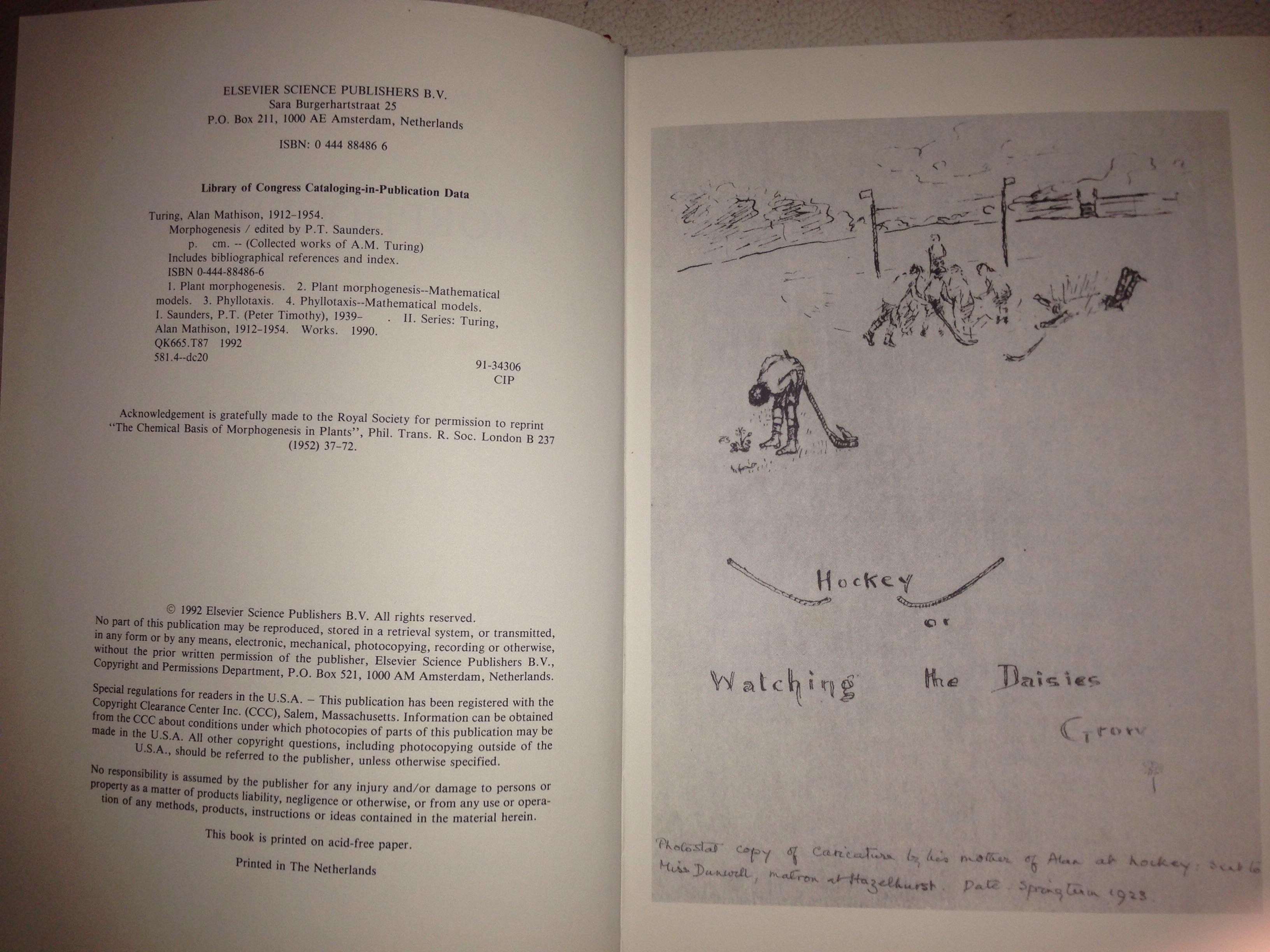
I typed in the preface to Morphogenesis, and scanned the drawing inside the front cover by Alan Turing's mother of her son watching the daisies grow:
https://news.ycombinator.com/item?id=15670473
http://donhopkins.com/home/archive/Turing/Morphogenesis.txt
https://en.wikipedia.org/wiki/P._N._Furbank
If for some irrational reason you choose to believe in the pseudoscience of Intelligent Design, then you might not like to hear what Turing thought about that, which P. T. Saunders mentions in the foreword to Turing's collected works, citing what Hodges wrote about and quoted Robin Gandy saying in his "excellent biography":
For Turing, however, the fundamental problem of biology had always been to account for pattern and form, and the dramatic progress that was being made at that time in genetics did not alter his view. And because he believed that the solution was to be found in physics and chemistry it was to these subjects and the sort of mathematics that could be applied to them that he turned. In my view, he was right, but even someone who disagrees must be impressed by the way in which he went directly to what he saw as the most important problem and set out to attack it with the tools that he judged appropriate to the task, rather than those which were easiest to hand or which others were already using. What is more, he understood the full significance of the problem in a way that many biologists did not and still do not. We can see this in the joint manuscript with Wardlaw which is included in this volume, but it is clear just from the comment he made to Robin Gandy (Hodges 1983, p. 431) that his new ideas were "intended to defeat the argument from design".
- 'The Chemical Basis of Morphogenesis', Alan Turing.
The last paper written by Alan Turing, "The Chemical Basis of Morphogenesis," [0] attempted to answer the theoretical explanation of the biological process that defines the shape of an embryonic organism from creation. This process is called "Morphogenesis". This is an important problem because complex organisms appear to be created by some "random" process that organises what appear to be self similar cells.
A lot of recent work has been done to experiment Turings ideas on "reaction-diffusion" processes describing morphogenesis in biology and other natural systems to see if a) they can be reproduced in the lab and b) mathematically model them. [1]
There is a pretty good broad outline of Turing and Morphogenesis in a BBC documentary, "The Secret Life of Chaos" [2] by Professor Jim Al-Khalili on Youtube. [3]
[0] Alan Turing, "THE CHEMICAL BASIS OF MORPHOGENESIS, http://www.dna.caltech.edu/courses/cs191/paperscs191/turing....
[1] Brandon Keim, Wired, "Alan Turing’s Patterns in Nature, and Beyond" http://www.wired.com/wiredscience/2011/02/turing-patterns/?p....
[2] Jim Al-Khalili, "The Secret Life of Chaos" http://www.bbc.co.uk/programmes/b00pv1c3
[3] Jim Al-Khalili, "The Secret Life of Chaos" http://www.youtube.com/watch?v=uF7gdlTrCQY
- >Another egregious weakness is biology. Wolfram displays absolutely no understanding of evolution, or what would be necessary to explain the adaptation of organisms to their environments. This is related to his peculiar views on methodology. If you want to get a rough grasp of how the leopard might get its spots, then building a CA model (or something similar) can be very illuminating. It will not tell you whether that's actually how it works. This is an important example, because there is a classic theory of biological pattern formation, or morphogenesis, first formulated by Turing in the 1950s, which lends itself very easily to modeling in CAs, and with a little fine-tuning produces things which look like animal coats, butterfly wings, etc., etc. The problem is that there is absolutely no reason to think that's how those patterns actually form; no one has identified even a single pair of Turing morphogens, despite decades of searching. [See "Update, 4 March 2012" below.] Indeed, the more the biologists unravel the actual mechanisms of morphogenesis, the more complicated and inelegant (but reliable) it looks. If, however, you think you have explained why leopards are spotted after coming up with a toy model that produces spots, it will not occur to you to ask why leopards have spots but polar bears do not, which is to say that you will simply be blind to the whole problem of biological adaptation.
The deranged Wolfram story I find most delightful is about the pains he took micromanaging the illustrations in his book, and how hard he is to work for. He required a photo of a leopard, to illustrate how its spots were similar to a reaction diffusion system. But he rejected the first leopard photo and demanded it be replaced by another, because he didn't like its facial expression.
I think it's charming how aesthetically picky he was about which cat pictures to use in his book. It's not enough for the science and mathematics behind the gigantic book to be ground breaking, revolutionary, earth shattering and astounding -- but also the leopard's smirk can't give readers the wrong impression.
https://writings.stephenwolfram.com/2022/05/the-making-of-a-...
>There were all sorts of unexpected challenges. I wanted an array of pictures of animals, to illustrate their range of pigmentation patterns. But so many of the pictures we could find (including ones I’d taken myself) we couldn’t use—because I considered the facial expressions of the animals just too distracting.
https://www.reddit.com/r/AnimalsBeingFunny/comments/165cmq1/...
Speaking of Turing's "The Chemical Basis of Morphogenesis":
https://news.ycombinator.com/item?id=42519371
>Alan Turing was fascinated with morphogenesis, and wrote an article by the title "The Chemical Basis of Morphogenesis". He modeled cell growth as a reaction-diffusion systems, now known as Turing Patterns. And he was firmly against and intended to defeat the religious claptrap pseudoscience we now call "Intelligent Design". [...]
>I typed in the preface to "Morphogenesis: Collected Works of A.M. Turing", and scanned the drawing inside the front cover by Alan Turing's mother of her son watching the daisies grow:
http://donhopkins.com/home/archive/Turing/Morphogenesis.txt
http://donhopkins.com/home/AlanTuringHockeyOrWatchingTheDais...
>[...]
And speaking of cellular automata, I'm also fascinated by the three levels of John von Neumann's universal constructors (mechanical, mathematical, quantum):
https://news.ycombinator.com/item?id=22304084
>Von Neumann had been interested in the applications of probability theory throughout his career; his work on the foundations of quantum mechanics and his theory of games are examples. When he became interested in automata, it was natural for him to apply probability theory here also. … His "Probabilistic Logics and the Synthesis of Reliable Organisms from Unreliable Components" is the first work on probabilistic automata … Whenever he discussed self-reproduction, he mentioned mutations … In Section 1.1.2.1 above and Section 1.8 below he posed the problems of modeling evolutionary processes in the framework of automata theory, of quantizing natural selection, and of explaining how highly efficient, complex, powerful automata can evolve from inefficient, simple, weak automata. A complete solution to these problems would give us a probabilistic model of self-reproduction and evolution. [9]
Burks, Arthur W., ed. Theory of Self-Reproducing Automata, by John von Neumann. Urbana: University of Illinois Press, 1966. Part I, p. 99, n. 9.
https://archive.org/details/theoryofselfrepr00vonn_0/page/n9...
- > The cows decided to solve the arms race problem by performing a single-party arms race in a way that caused minimal damage and, preferably, was not noticed at all by anyone. This is why their 'winner take all' approach to neural network AI also describes their overall strategic approach, a semantic detail which which at least some of them found funny. The results of this arms race could then be forever locked away from humanity. The system could be trained to, for example, endlessly twiddle its thumbs and do nothing else but jealously guard its 'ecosystem'. This would effectively deny QNN technology to humans, as any new attempts at such would be quickly detected and pwned. The cows would force humanity to forever relinquish QNN technology. Relinquishment was the only way to prevent unintended consequences from destroying humanity. If possible and safe the cows wanted to give humanity some of the less-dangerous benefits of QNN technology. Thus their actual goal was partial relinquishment."
> Science-oriented readers might wonder just what sort of QC could have been built a full 18 years ago, when current technology is just nearing the point of developing a useful QC. The answer is that they generated a 'teleportation/entanglement-based winner-take-all style recurrent topological quantum neural network', then trained it to emulate a Quantum Turing Machine that could run Shor's Algorithm. It exists in the physical form of a complex system composed of 'anyons' interacting with each other within a 'two dimensional electron gas'. Anyons can be generated by moving precision arrays of powerful electromagnets very near the surface of the 2DEG, like creating whirlpools in the bathtub with your hand. I strongly suspect the scientists involved discovered a rule, analogous to Rule 110, that operates directly on the physical system of anyons within a 2DEG. For the detailed scientific underpinnings I suggest you study the collected works of Stuart Kauffman, Steven Wolfram, David Deutsch, and Robert Laughlin. You have no reason to trust what I'm saying, and disinformation is entirely too common, but I want readers to understand that it is possible for a sufficiently determined and intelligent person to verify that what I just said is probably true, although certainly NOT just by Googling for it :-)
> The underlying physical system for this type of QNN is interactions between non-abelian anyons in a two dimensional electron gas (2DEG). The primary math required is a branch of Knot Theory called Braid Theory. Obviously, the primary purpose of this system, from the Five Eyes/Echelon perspective, is to run Shor's algorithm to crack public/private key cryptography. A perusal of current known quantum algorithms, combined with a survey of current advanced AI applications, may suggest other uses.
1. http://postquantumhistoricalretrospective.blogspot.com
2. http://postquantumhistoricalretrospective.blogspot.com/2012/...
3. http://postquantumhistoricalretrospective.blogspot.com/p/tim...
And the kicker
> The QC approach that actually works, in a production-ready scale-able way, is to run a virtual Turing machine atop a winner-take-all-style teleportation/entanglement-based recurrent topological quantum neural network (QNN). Even a basic (multilayer) neural network is Turing Complete, because a NN can perfectly emulate an XOR gate, and multiple XOR gates can be used to construct a Turing machine. A quantum neural network can emulate a quantum Turing machine. Someone, somewhere, is due to be awarded the Grand Prize Turing Award, for solving Turing's unfinished Morphogenesis problem, and then implementing Turing's original machine on the resulting artificially intelligent 'organism'. I'm inclined towards neither spiritualism nor whimsy, but were I so, then I might suspect that, after he died in 1954, Alan Turing reincarnated quickly, in 1965, in order to finish his incomplete life work. The classified nature of the work probably precludes any awards. I'd really like it if this whole thing was declassified, but fear we'll have to wait many additional decades for that. This QNN is an excellent candidate to pursue adiabatic (reversible) quantum computing (AQC), might be helpful for certain approaches to advanced nanotechnology, and, were it declassified, might also be helpful to many other scientific ventures. Per the Ultra Secret, it's undoubtedly still considered 'national security', even if it's becoming an open secret within the Intelligence Community.
- I come at this more from the (amateur) history of science angle (meaning I am in no way qualified to speak about recent work in this field) so take this with a grain of salt, but it all seems very much in the vein of Turing's late work "The Chemical Basis of Morphogenesis". Essentially, one of the first things Turing did when he had regular access to a real computer (and not some lashup being used to break German ciphers) was to use it to simulate how life might arise from ordinary chemical reactions. In other words, Turing himself was using a Turing machine (well, a Ferranti Mk 1 I think, so more of a Von Neuman machine) to simulate what ended up being the path to "super-Turing" models of computation!
- The chemical Basis of Morphogenesis - Alan Turing
https://en.wikipedia.org/wiki/The_Chemical_Basis_of_Morphoge...
Related

A new kind of science
44 recommend · 388

The Annotated Turing
56 recommend · 93

The (new) turing omnibus
32 recommend · 42

Computing machinery and intelligence
10 recommend · 68

Mathematical Biology
2 recommend · 5

Turing's cathedral
42 recommend · 75