Stats for nerds
0recommend
4mentions
4people
2013–2019years
100% neutral
Mentions per year
What Hacker News says
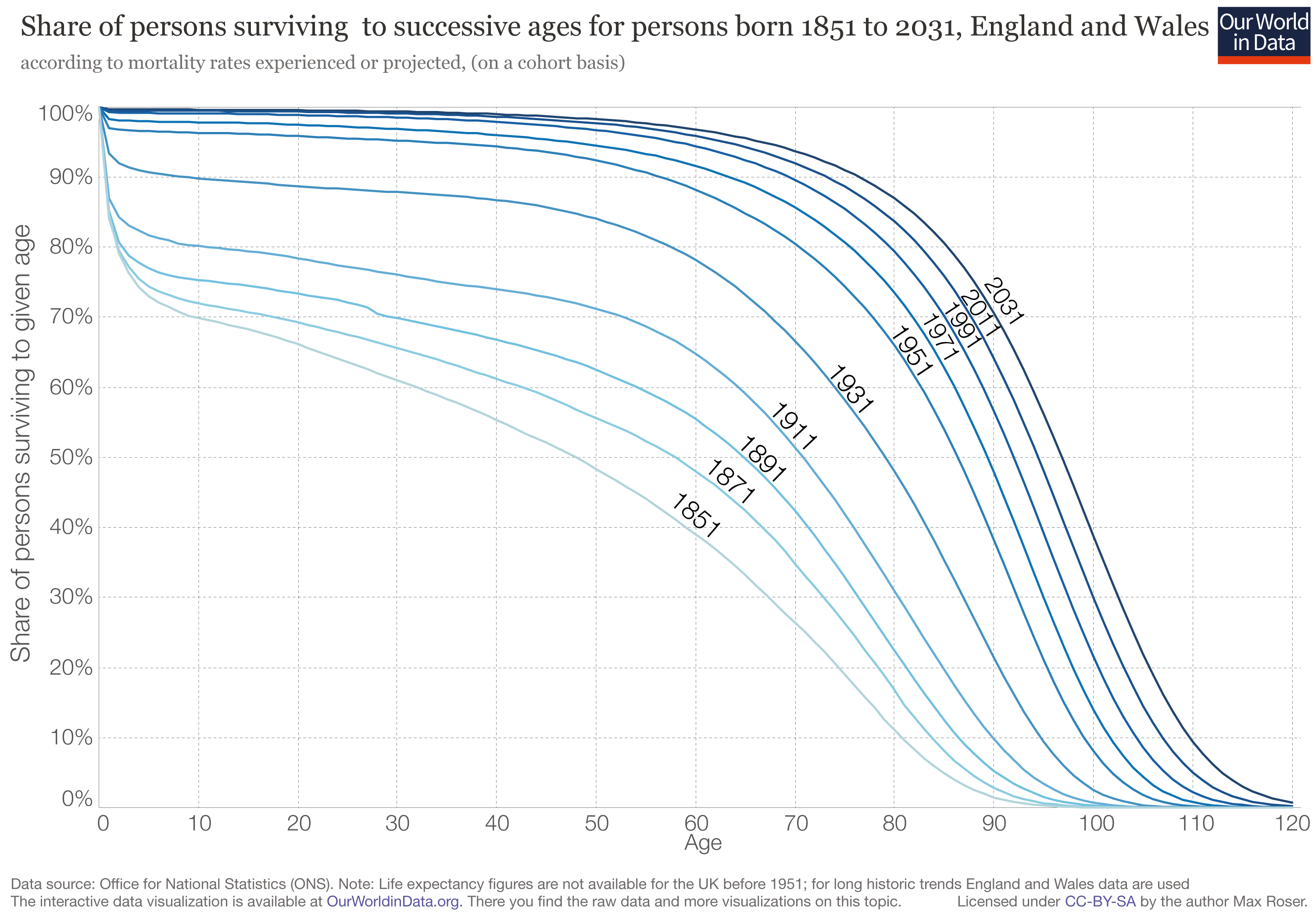
- It was quite surprising for me to read (in Angus Deaton’s The Great Escape - Nobel laureate) that most of the advances on living longer that we have achieved are basically focused on not dying young (baby, infant, adolescent); but that the overall limit has been fixed in its place since hundreds of years ago.
Look at the shapes of this and to what do they converge:
https://ourworldindata.org/uploads/2017/08/Survival-Curves-U...
(That comes from this article by the way: https://ourworldindata.org/life-expectancy)
Im trying to find a chart of the evolution of age-specific mortality rate that very clearly shows that we have a mortality plateau up until about 30-35 years, and then the rate increases linearly. It is quite humbling.
EDIT: This is the best I found: https://www.researchgate.net/profile/Gerardo_Chowell/publica...
It is from Canada. The aforementioned book shows time series of several countries and periods, and helps driving the point home that (non-intentional) adult mortality has been more or less fixed since a long time ago.
- I truly applaud the efforts of the funds. I don't think I could come up with any more noble endeavor, and I know there are some very capable people throughout their organizations who are dedicated to spending the funds wisely and impactfully.
However, is it fair to credit philanthropy as the sole cause of quality of life improvements across the most destitute populations?
I think there is a fair amount of evidence that suggests development funding can have as much disastrous consequence as good. In his book The Great Escape[1], Angus Deaton (Nobel Prize economist) describes how non-interventionist economic development seems to have been the main driver of better outcomes across the world, and not the flush pockets of westerners, as convenient as that would be. Another book called The Road To Hell[2] provides many examples where large charitable efforts regularly produce even worse outcomes than no intervention at all. Is there some good evidence to suggest that the money spent by the Gates Foundation and other charities were solely responsible for the improved qualities of life across whole populations?It's a story about the stunning gains the poorest people in the world have made over the last 25 years. This incredible progress has been made possible not only by the generosity of Warren and other philanthropists, the charitable giving of individuals across the world, and the efforts of the poor on their own behalf, but also by the huge contributions made by donor nations, which account for the vast majority of global health and development funding.If you want to posit that their efforts have been invaluable in improving access to medical services across the globe, you'll get no argument from me. However, that's a small part of what makes up "stunning gains."
[1] https://www.amazon.com/Great-Escape-Health-Origins-Inequalit...
[2] https://www.amazon.com/Road-Hell-Michael-Maren/dp/0743227867
- > Is a kid worth less than a working parent?
This is an interesting question Angus Deaton talks about in "The Great Escape"
So a baby knows hardly any one but has their life ahead of them.
Where as a old person has less years but their death effects more people.
Once you get into a working ability, it depends on their job and qualifications.
It's not an easy question to answer.
But I'd say a young working parent is worth more than a kid.
- Article posted below to avoid having to delete dom nodes: ______________________________________
Tycoon Warning: How the obscenely rich are becoming the new dictators of the 21st century.
Earlier this month, the investment bank Credit Suisse published its annual survey of global wealth. The bank's report is filled with illuminating findings, but one in particular caught my eye. It has to do with the distribution of assets in Russia, where, as the report notes, a mere 110 people own a mind-boggling 35 percent of the country's entire wealth. At the same time, 93.7 percent of Russians are worth $10,000 or less.
As the report notes, this makes Russia the country with the greatest wealth disparities in the world. Americans, who are now increasingly concerned about deepening inequality in their own country, might seek some consolation from this dismal conclusion. Even under present circumstances, wealth in the United States is still spread a lot more evenly than that (as this comparison shows). Things could be worse, right?
Well, maybe. But I see little cause for jubilation. Russia is merely the most extreme case of a worldwide trend that potentially represents one of the greatest threats that democracy faces today: the spread of oligarchy.
The problem isn't just that some people in today's world are fabulously rich. It's that disproportionate wealth increasingly goes along with disproportionate power. Russia, again, offers a textbook example of the dangers. Back in the 1990s, a handful of politically well-connected business tycoons managed to profit from their close relations with Boris Yeltsin's Kremlin by taking advantage of the privatization of the country's industrial jewels -- above all its vast oil wealth. Those magnates weren't shy about exploiting their economic power to political ends. They bankrolled Yeltsin's re-election as president in 1996, controlled ministerial appointments, and dictated government policy. No wonder these businessmen-cum-politicians were soon dubbed the "oligarchs." ("Oligarchy" is Greek for "government of the few.")
One of them, the recently deceased, arch-Machiavellian Boris Berezovsky, engineered the rise of an ex-KGB officer to the prime ministership. Vladimir Putin ultimately proved less than grateful, though. Once Putin became president in his own stead, he was quick to cut his erstwhile patron down to size, forcing Berezvosky into exile. Putin curtailed the power of other Yeltsin-era tycoons, too (most notably Mikhail Khodorkovsky, who today marks his 10th year of imprisonment in a labor camp), but in their place he raised up a new group of businessmen -- many with ties to the old Soviet security services -- who owed their fortunes to him. One of them, another KGB alumnus named Igor Sechin, who heads the country's largest oil company, is regarded by some as the second-most powerful man after Putin himself. (Sechin is shown at left in the photo above.)
But this isn't only Russia's problem. As has now become apparent, globalization and the powerful economic forces it has unleashed have awarded unparalleled wealth and power to a tiny new elite. Call them what you will: the superclass, the plutocrats, the "global meritocracy." What they exemplify is the nexus of wealth and political power. And that's a problem that is increasingly vexing voters in places from London to Kuala Lumpur.
It's a challenge that takes different forms. In China, membership in the ruling Communist Party is often the easy road to wealth. Many of today's political scandals center on the antics of well-connected "princelings," the descendants of senior party officials who embody the country's peculiarly potent blend of Marxist-Leninist crony capitalism. Thanks to some remarkable digging by enterprising journalists in recent years, we've learned some astonishing things about the scale of privilege enjoyed by the extended families of notables such as President Xi Jinping and ex-Prime Minister Wen Jiabao. But this hardly comes as a surprise. When you consider that the People's Republic is governed by the seven members of the Standing Committee of the Politburo of the Communist Party, you're talking about a tiny number of families who exercise unchecked control over one of the world's largest economies. In such a setting, it's only natural that political and economic power are mutually reinforcing.
The situation in China is, of course, the outcome of an economic liberalization program steered by an autocratic elite. In the countries of the developed West the situation is rather different. The number of players is larger; wealth and political influence are more widely distributed. But that is presumably small comfort to, say, the Americans who have emerged as losers from the country's latest Gilded Age. Economic equality in the United States grew steadily during the first three decades of the period following World War II, but ground to a halt amid the stagflation and increasing international competition of the 1970s. As economist Joseph Stiglitz notes in a recent editorial:
"Last year, the top 1 percent of Americans took home 22 percent of the nation's income; the top 0.1 percent, 11 percent. Ninety-five percent of all income gains since 2009 have gone to the top 1 percent. Recently released census figures show that median income in America hasn't budged in almost a quarter-century."
At the same time, the extraordinary permissiveness of U.S. laws on lobbying and campaign financing has allowed wealthy elites to gain immense sway over the political process. By now, anyone who follows American politics has heard the stories about the vast sums of cash spent by conservative business magnates like the Koch Brothers; less often discussed, perhaps, are the rich Democrats, such as George Soros or Tom Steyer, who are happy to leverage their wealth to shape policy. But even less visible are the big corporations and industrial associations who can purchase lawmakers and fix legislation to boost their own bottom lines.
One recent academic study calculates that 40 percent of political campaign contributions in 2012 came from one hundredth of one percent of U.S. households. That figure probably reflects the new economic elite's growing awareness of its own political power -- not to mention the apathy among other segments of the population who feel increasingly divorced from meaningful participation. The erosion of alternate power centers, such as labor unions, undoubtedly contributes to a sense of rising cynicism and disengagement. It all serves to undermine the promise of America's democratic system. (Given this context, it's no wonder that the U.S. Supreme Court is once again weighing the question of limits on individual contributions to political campaigns.)
As a result, the United States is now experiencing a remarkable discussion of the causes of the new inequality and its political consequences. Authors from George Packer to Tyler Cowen are stirring impassioned debate about the perceived breakdown of the American social compact. The new book from economist Angus Deaton, The Great Escape (see DemLab's excerpt here), includes a memorable quote from the lawyer Louis Brandeis: "If democracy becomes plutocracy, those who are not rich are effectively disenfranchised."
Can we stop the trend? Some -- like Cowen, who believes that current inequality is largely a function of technological change -- are skeptical. Others insist that we can counter the drift towards government by the few with smart policies designed to level the playing field -- above all in education, infrastructure, and health care. Measures to limit the role of money in politics probably wouldn't be a bad idea either (presuming we can find some that actually work). For those who still believe in the primacy of the market, the package might also include measures designed to promote genuine competition in the place of today's corporate welfare for politically plugged-in superfirms.
This certainly doesn't mean giving up on capitalism. As development economists point out, globalization has brought relative prosperity to many around the world who couldn't even dream of it before. (Think, for a start, of all those Chinese peasants who can now afford three meals a day -- unthinkable in times past.) Overall health and development indicators have improved dramatically over the past fifty years. But none of this obviates the need to ensure that the extraordinary benefits accruing to the superstars at the top don't end up disenfranchising the rest of us. Otherwise the future looks dark.
But will the wealthy really give up their acquired power that easily? Though Occupy Wall Street targeted the 1 percent with considerable verve and passion, its actual political impact was arguably close to zero. It's high time for new political movements that can aggregate the power of individuals and marshal coherent responses to the intensifying concentration of influence by a few at the top. And there's even the chance that some of the more enlightened plutocrats will offer ideas for empowering the majority. Where's Bill Gates when you need him?