Stats for nerds
4recommend
24mentions
12people
2011–2026years
17% recommend83% neutral
Mentions per year
What Hacker News says
- IMHO, I'd date the concept of artificial life further back than Christopher Langton. I'd start with Von Neumann's Theory of Self-Reproducing Automata. Though the book was published in 1966, Von Neumann was working on the concept as early as the 1940s. In his work,
"He asked what is the threshold of complexity that must be crossed for machines to be able to evolve. His answer was to specify an abstract machine which, when run, would replicate itself. In his design, the self-replicating machine consists of three parts: a "description" of ('blueprint' or program for) itself, a universal constructor mechanism that can read any description and construct the machine (sans description) encoded in that description, and a universal copy machine that can make copies of any description." From wikipedia [1]
[1]. https://en.wikipedia.org/wiki/Von_Neumann_universal_construc...
- Von Neumann died before he finished writing this book.
Another unfinished work of his that's worth checking out is Theory of Self-Reproducing Automata where he introduces his conception of self-replicating automata [1].
[1] https://en.wikipedia.org/wiki/Von_Neumann_universal_construc...
- Most of my favourites have already been listed but one I found particularly interesting was Von Neumann's Theory of Self-Reproducing Automata [0].
- I've been reading Von Neumann's "Theory Of Self-Reproducing Automata" (freely available on Internet Archive and very much worth it!) and he constantly references and credits Turing. Nor have I ever heard anyone claim Turing's insights were sparked in a vacuum (or anyone's, for that matter ... the closest to a "lone genius" I can think of is Newton maybe? -- This is a good tangential question perhaps: who have made the most "out of thin air" discoveries in math or science?).
- >Another egregious weakness is biology. Wolfram displays absolutely no understanding of evolution, or what would be necessary to explain the adaptation of organisms to their environments. This is related to his peculiar views on methodology. If you want to get a rough grasp of how the leopard might get its spots, then building a CA model (or something similar) can be very illuminating. It will not tell you whether that's actually how it works. This is an important example, because there is a classic theory of biological pattern formation, or morphogenesis, first formulated by Turing in the 1950s, which lends itself very easily to modeling in CAs, and with a little fine-tuning produces things which look like animal coats, butterfly wings, etc., etc. The problem is that there is absolutely no reason to think that's how those patterns actually form; no one has identified even a single pair of Turing morphogens, despite decades of searching. [See "Update, 4 March 2012" below.] Indeed, the more the biologists unravel the actual mechanisms of morphogenesis, the more complicated and inelegant (but reliable) it looks. If, however, you think you have explained why leopards are spotted after coming up with a toy model that produces spots, it will not occur to you to ask why leopards have spots but polar bears do not, which is to say that you will simply be blind to the whole problem of biological adaptation.
The deranged Wolfram story I find most delightful is about the pains he took micromanaging the illustrations in his book, and how hard he is to work for. He required a photo of a leopard, to illustrate how its spots were similar to a reaction diffusion system. But he rejected the first leopard photo and demanded it be replaced by another, because he didn't like its facial expression.
I think it's charming how aesthetically picky he was about which cat pictures to use in his book. It's not enough for the science and mathematics behind the gigantic book to be ground breaking, revolutionary, earth shattering and astounding -- but also the leopard's smirk can't give readers the wrong impression.
https://writings.stephenwolfram.com/2022/05/the-making-of-a-...
>There were all sorts of unexpected challenges. I wanted an array of pictures of animals, to illustrate their range of pigmentation patterns. But so many of the pictures we could find (including ones I’d taken myself) we couldn’t use—because I considered the facial expressions of the animals just too distracting.
https://www.reddit.com/r/AnimalsBeingFunny/comments/165cmq1/...
Speaking of Turing's "The Chemical Basis of Morphogenesis":
https://news.ycombinator.com/item?id=42519371
>Alan Turing was fascinated with morphogenesis, and wrote an article by the title "The Chemical Basis of Morphogenesis". He modeled cell growth as a reaction-diffusion systems, now known as Turing Patterns. And he was firmly against and intended to defeat the religious claptrap pseudoscience we now call "Intelligent Design". [...]
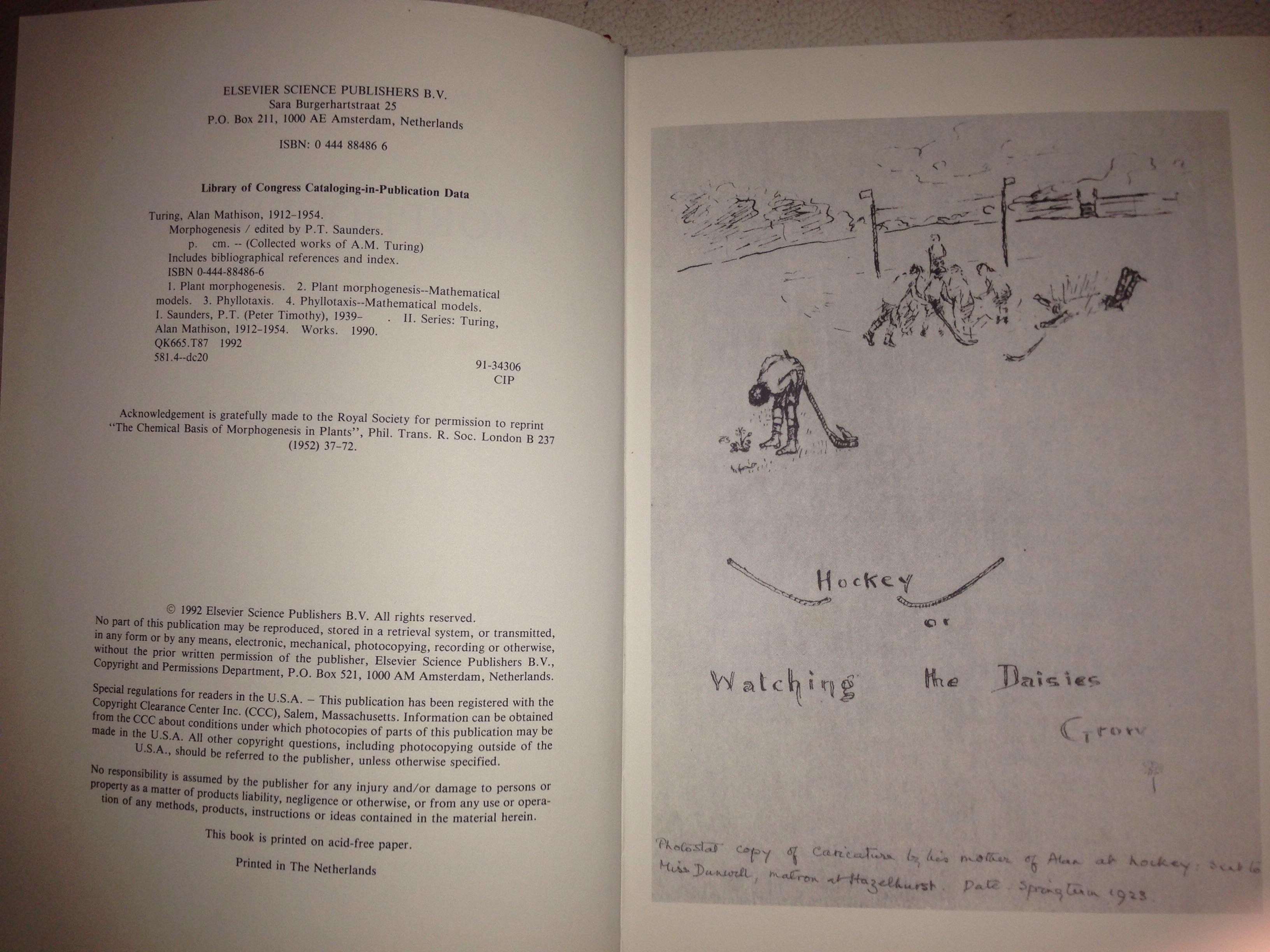
>I typed in the preface to "Morphogenesis: Collected Works of A.M. Turing", and scanned the drawing inside the front cover by Alan Turing's mother of her son watching the daisies grow:
http://donhopkins.com/home/archive/Turing/Morphogenesis.txt
http://donhopkins.com/home/AlanTuringHockeyOrWatchingTheDais...
>[...]
And speaking of cellular automata, I'm also fascinated by the three levels of John von Neumann's universal constructors (mechanical, mathematical, quantum):
https://news.ycombinator.com/item?id=22304084
>Von Neumann had been interested in the applications of probability theory throughout his career; his work on the foundations of quantum mechanics and his theory of games are examples. When he became interested in automata, it was natural for him to apply probability theory here also. … His "Probabilistic Logics and the Synthesis of Reliable Organisms from Unreliable Components" is the first work on probabilistic automata … Whenever he discussed self-reproduction, he mentioned mutations … In Section 1.1.2.1 above and Section 1.8 below he posed the problems of modeling evolutionary processes in the framework of automata theory, of quantizing natural selection, and of explaining how highly efficient, complex, powerful automata can evolve from inefficient, simple, weak automata. A complete solution to these problems would give us a probabilistic model of self-reproduction and evolution. [9]
Burks, Arthur W., ed. Theory of Self-Reproducing Automata, by John von Neumann. Urbana: University of Illinois Press, 1966. Part I, p. 99, n. 9.
https://archive.org/details/theoryofselfrepr00vonn_0/page/n9...
- This reads like marketing fluff, but I am reminded of John von Neumann's "Theory of Self-Reproducing Automata"; that the very first people who worked on deductive machines immediately started thinking about machines building themselves, and what the rules of that would look like. I am not surprised that during the inductive revolution we are having similar thoughts.
Related

Introduction to automata theory, languages, and computation
24 recommend · 37

Introduction to the theory of computation
66 recommend · 96

The Little Schemer
288 recommend · 652

Theory of computation
14 recommend · 21

An introduction to formal languages and automata
4 recommend · 5

Automata, Computability and Complexity
1 recommend · 2