The Elements of Networking Style
The World's Only Know Constructively Snotty Computer Science Book: historically, its polemics for TCP/IP and against the international standardsmongers' "OSI" helped the Internet happen; currently, its principles of technoaesthetic criticism are still eminently applicable to the States of most (probably all) technical Arts-all this and Cover Cartoons, too but it's not for those who can't deal with real sentences
Stats for nerds
8recommend
13mentions
9people
2013–2023years
77% recommend23% neutral
Mentions per year
What Hacker News says
- Apparently Mike Padlipsky lived in vain [1].
I'm surprised you did not mention his work. Defining and critiquing the reference models in the case of the ARPAnet and OSI was his thing. Much of it was published in a (quite funny) book The Elements of Networking Style[2], partially taken from some of his RFCs.
- Two of my favourites;
* Confessions of a Used Program Salesman: Institutionalizing Software Reuse by Will Tracz.
* The Elements of Networking Style: And Other Essays & Animadversions on the Art of Intercomputer Networking by Mike Padlipsky.
- Scaling is not a goal of the OSI model, and TCP/IP predates (and does not adhere to) the OSI model anyway. For insight into how and why this came about, I recommend Padlipsky's "The Elements of Networking Style."
- Yay! I love that book!
"A really vicious critique of the misguided ISO networking standards attempt, written when the 'OSI model' was trendy & lots of people were babbling about the sacred seven layers."
https://news.ycombinator.com/item?id=19866389
Pfff, TCP/IP will never succeed. It doesn't have enough layers! /s
https://archive.org/details/elementsofnetwor00padl
"The Book": The Elements of Networking Style: And Other Essays & Animadversions of the Art of Intercomputer Networking, by M. A. Padlipsky (1985)
The World's Only Know Constructively Snotty Computer Science Book: historically, its polemics for TCP/IP and against the international standardsmongers' "OSI" helped the Internet happen; currently, its principles of technoaesthetic criticism are still eminently applicable to the States of most (probably all) technical Arts-all this and Cover Cartoons, too but it's not for those who can't deal with real sentences.
Standards: Threat or Menace, p. 193
A final preliminary: Because ISORM is more widely touted than TCP/IP, and hence the clearer present danger, it seems only fair that it should be the target of the nastier of the questions. This is in the spirit of our title, for in my humble but dogmatic opinion even a good proposed Standard is a prima facie threat to further advance in the state of the art, but a sufficiently flawed standard is a menace even to maintaining the art in its present state, so if the ISORM school is wrong and isn't exposed the consequences could be extremely unfortunate. At least, the threat / menace paradigm applies, I submit in all seriousness, to protocol standards; that is, I wouldn't think of being gratuitously snotty to the developers of physical standards -- I like to be able to use the same cap to reclose sodapop bottles and beer bottles (though I suspect somebody as it were screwed up when it came to those damn "twist off" caps) -- but I find it difficult to be civil to advocates of "final," "ultimate" standards when they're dealing with logical constructs rather than physical ones. After all, as I understand it, a fundamental property of the stored program computer is its ability to be reprogrammed. Yes, I understand that to do so costs money and yes, I've heard of ROM, and no I'm not saying that I insist on some idealistic notion of optimality, but definitely I don't think it makes much sense to keep trudging to an outhouse if I can get indoor plumbing . . . even if the moon in the door is exactly like the one in my neighbor's.
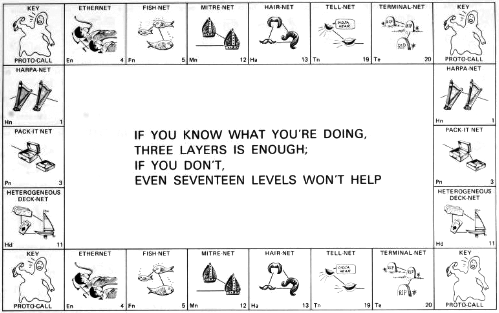
Appendix 3, The Self-Framed Slogans Suitable for Mounting
https://donhopkins.com/home/Layers.png
https://en.wikipedia.org/wiki/Michael_A._PadlipskyIF YOU KNOW WHAT YOU'RE DOING, THREE LAYERS IS ENOUGH; IF YOU DON'T, EVEN SEVENTEEN LEVELS WON'T HELPOn the occasion of The Book's reissuance, Peter Salus wrote a review in Cisco's Internet Protocol Journal which included the following observations:
Padlipsky brought together several strands that managed to result in the perfect chord for me over 15 years ago. I reread this slim volume (made up of a Foreword, 11 chapters (each a separate arrow from Padlipsky's quiver) and three appendixes (made up of half a dozen darts of various lengths and a sheaf of cartoons and slogans) several months ago, and have concluded that it is as acerbic and as important now as it was 15 years ago. [Emphasis added] The instruments Padlipsky employs are a sharp wit (and a deep admiration for François Marie Arouet), a sincere detestation for the ISO Reference Model, a deep knowledge of the Advanced Research Projects Agency Network (ARPANET)/Internet, and wide reading in classic science fiction.
In a lighter vein, The Book has been called "... beyond doubt the funniest technical book ever written."
- The Elements of Networking Style, by Michael Padlipsky - an (extremely!) opinionated critique of the OSI model vs the Arpanet (TCP/IP) model.
- Inventing the Internet (https://mitpress.mit.edu/books/inventing-internet) is a fantastic place to start
Innovations in Internetworking (https://www.amazon.com/Innovations-Internetworking-Artech-Te...) is a great collection of papers that help you understand the original thinking behind each protocol
The Elements of Networking Style (https://www.amazon.com/Elements-Networking-Style-Animadversi...) explains why you see only 4 layers in the real Internet while ISO slices it into 7 and all the fun parts os standard bodies while retaining a unique sense of satire
Related

An engineering approach to computer networking
2 recommend · 12

Hands-On Network Programming with C
2 recommend · 2

Internet architectures
2 recommend · 3

Mathematical Foundations of Computer Networking
3 recommend · 6

The illustrated network
3 recommend · 6

Understanding Linux network internals
2 recommend · 7